
AI Adoption and Strategy in Public Pension Administration
NCPERS Research Brief: August 2026
 Public pension systems are navigating an inflection point with artificial intelligence. While AI tools are entering the day-to-day operations of some funds, primarily in administrative efficiency and member communications, the sector remains in early stages of adoption. Widespread uncertainty remains about where the technology belongs in fiduciary decision-making.
This NCPERS Research Brief summarizes key findings from a 2026 NCPERS survey of senior public pension professionals on AI adoption and strategy. Findings draw on responses from 33 participants representing funds of varying size, from small systems managing under $1 billion in assets to large systems overseeing $50 billion or more.
Key Findings at a Glance
58%
of respondents are optimistic or very optimistic about AI’s impact on defined benefit pension administration over the next decade.
96%
describe human judgment as the primary driver of decisions where AI is used.
63%
of respondents cited the top barrier to AI expansion as a lack of in-house technical expertise to evaluate or oversee AI tools.
43%
of respondents said that their top risk concern is cybersecurity vulnerabilities from AI systems or vendors.
Where Things Stand: AI Adoption by Function
Among the functions surveyed, member communication and customer service shows the highest rate of active AI use, though at 16% of respondents that figure represents a small number of systems. A larger share report piloting or considering AI in that function. Administrative task automation follows a similar pattern. At the other end of the spectrum, asset-liability management and LDI strategy sees the lowest engagement, with 77% of respondents not considering AI for that purpose.
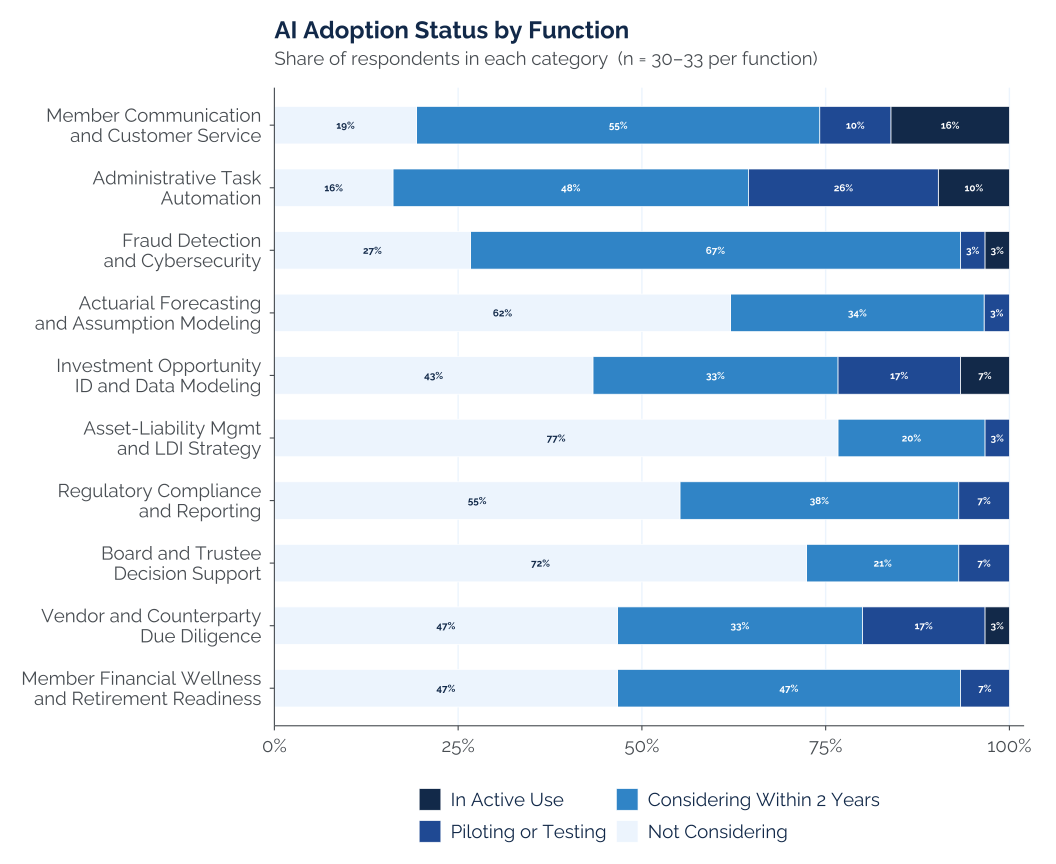
The overall pattern is one of cautious, productivity-focused experimentation rather than strategic integration. Funds are using AI to draft communications, summarize documents, and automate routine tasks, functions where errors are recoverable and human review is routine. They are not yet using it in the actuarial, investment, and governance functions where the stakes for long-term funding are highest.
“We have begun evaluating Microsoft 365 Copilot with managers and a select group of staff. The tool is primarily being used to assist with drafting emails, summarizing meetings and documents, preparing presentations, and generating initial content for reports. Overall, feedback has been positive, with users reporting time savings and improved efficiency.” (Survey respondent)
This bifurcation between large and small funds is visible throughout the responses. Smaller systems, often with staffs of fewer than ten, frequently note that they lack the internal capacity to evaluate, implement, or oversee AI tools, and that this constraint is not merely a matter of resources but of risk management.
AI Governance: Frameworks on Paper and in Practice
The AI governance picture highlights the challenges of developing a formal policy for rapidly evolving technologies. While 43% of respondents report operating under internal staff guidelines and 18% have a formal board-approved AI policy, 18% report no governance framework of any kind, and the plurality are operating in the space between: referencing existing technology or vendor risk policies that were never designed with AI in mind, or applying informal case-by-case judgment.
More telling is what respondents described when asked how their governance framework actually operates in practice. The survey posed a direct scenario question: if a member of your team discovered that an AI tool had produced a significant error in an actuarial output, a fraud flag, or a member communication, what would actually happen? The answers were candid.
“Have not yet worked through this.” (Survey respondent)
“We have not formally worked through this scenario, but AI use is pre-approved presently.” (Survey respondent)
“In practice, our approach centers on the principle that AI is an assistive tool, not a decision-maker. Any actuarial calculations, fraud-related flags, benefit determinations, or official member communications generated or assisted by AI would still be subject to human review and existing internal controls before being finalized or acted upon.” (Survey respondent, larger fund)
Only a small number of respondents described a formal escalation path. The most common response was some version of: accountability sits with the employee who used the tool. Several funds noted they are currently developing governance frameworks but have not yet completed them. The gap between governance on paper and governance in practice is the central challenge this survey surfaces.
Oversight: What Controls Exist
The most commonly applied oversight practice is human review of AI outputs before action is taken, cited by 69% of respondents. Most organizations using AI report at least some form of oversight in place, though 27% report no formal oversight practices, suggesting room for growth as adoption expands.
Independent third-party validation of AI models and regular audits of AI model performance are the least commonly applied practices, suggesting that most oversight is procedural rather than technical. Funds are requiring human eyes on outputs, but few are systematically evaluating whether the underlying models are performing reliably over time.
The Human Judgment Question
One of the clearest findings in the survey is that public pension professionals maintain a strong commitment to human primacy in AI-assisted decisions. Ninety-six percent of respondents describe human judgment as primary in any area where AI is used, with the single most common characterization (selected by 50%) being that AI outputs are one input among several. An additional 46% go further, describing AI as being used only to surface information, not to recommend.
“AI should be used primarily to augment employees, improve service delivery, enhance operational efficiency, and support decision-making, not replace human judgment in critical benefit, eligibility, or fiduciary decisions.” (Survey respondent)
“You need the expert to be able to gauge reasonableness of the output. I don’t believe AI will ever be trustworthy of 100% accuracy, and for that reason we will always need to be developing staff to at the very least be a watchful eye.” (Survey respondent)
The challenge implicit in this position is that it requires maintaining internal expertise in precisely the domains where AI is being used, which loops back to the capacity constraints that many respondents identify as their primary barrier.
Barriers and Risk Concerns
What Is Holding Systems Back from AI Adoption?
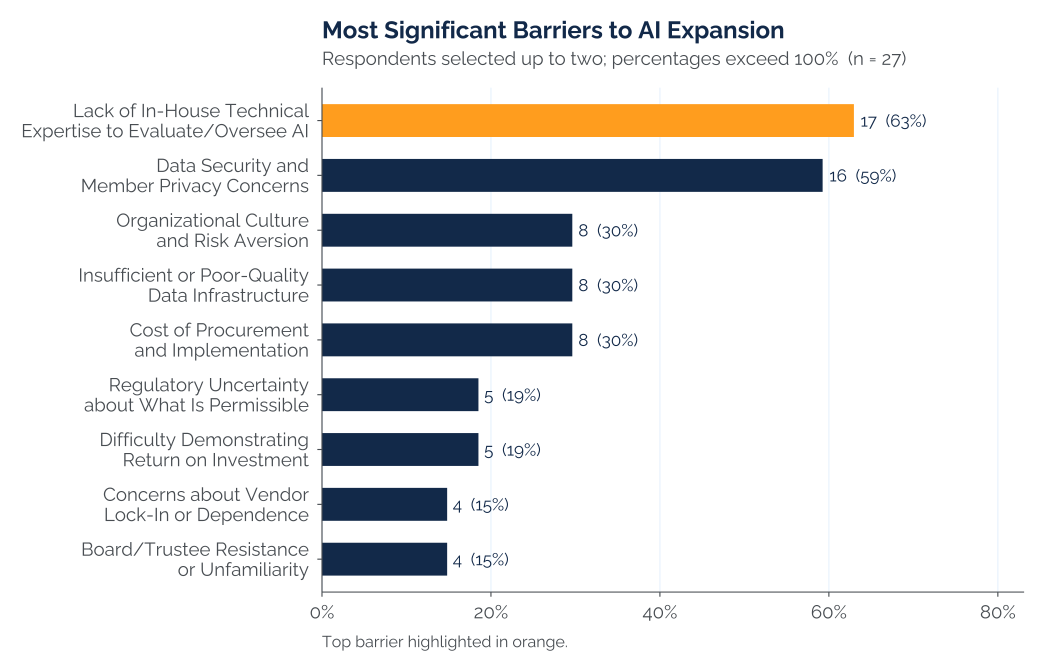
The two most commonly cited barriers reveal a fundamental readiness problem rather than a resource or regulatory one. Sixty-three percent of respondents cite lack of in-house technical expertise to evaluate or oversee AI tools, and 59% cite data security and member privacy concerns. These are not barriers that larger budgets alone can solve.
63%
Lack of in-house technical expertise to evaluate or oversee AI
59%
Data security and member privacy concerns
30%
Cost of procurement and implementation
30%
Organizational culture and risk aversion
What Pension Leaders Fear Most
Cybersecurity vulnerabilities from AI systems or vendors is the top single risk concern, named by 43% of respondents. Data quality problems producing unreliable results follows. Notably, the concern about model errors with long-term funding consequences, perhaps the most distinctive risk in the defined benefit context, is cited less frequently, which may reflect that relatively few respondents are yet using AI in actuarial or long-horizon modeling functions where such errors would manifest.
“The most important question the survey did not ask is: How should fiduciary responsibility and accountability be allocated when AI-assisted processes contribute to decisions affecting member benefits, investments, or actuarial assumptions?” (Survey respondent)
AI Outlook for Public Pensions: Mid-Year 2026
Despite the governance gaps and capacity constraints documented above, the sector’s overall orientation toward AI is cautiously optimistic. Among the responding plans, 54% are cautiously optimistic and 4% are very optimistic about AI’s impact on public pensions over the next decade. Twenty-five percent describe the risks and opportunities as roughly balanced, and 18% are cautiously pessimistic. No respondents described themselves as very pessimistic.
The optimism comes alongside an acknowledgment that most organizations are still working through the strategic implications of AI. Only 7% of respondents report having reached a clear strategic position and are executing against it. The remainder are distributed across postures that reflect early-stage deliberation: waiting to see how peers and regulators move, actively working through the question without a settled position, or having AI on the agenda without dedicated leadership attention yet. This distribution reflects where the field is, not where it is headed.
“The long-term challenge for public pension organizations is not whether AI can be implemented, but how it can be implemented responsibly while maintaining the confidence of members, retirees, employers, and other stakeholders.” (Survey respondent)
Implications for NCPERS Members
These preliminary findings point to several areas where NCPERS members would benefit from focused guidance and peer learning:
- Practical governance guidance. Many organizations are actively developing AI governance frameworks. NCPERS can help by providing model policies, scenario-based planning tools, and examples of how peer organizations are structuring oversight and accountability.
- AI evaluation capacity. The most commonly cited barrier is not cost but expertise. Members would benefit from accessible frameworks for evaluating AI vendor claims, assessing model reliability, and setting contractual requirements that protect the fund.
- Defined benefit-specific use case guidance. Most current AI use involves general productivity tools. As the field matures, guidance on where AI fits in actuarial, investment, and member-service workflows specific to DB plans will help funds make more deliberate and confident choices.
- Peer learning and benchmarking. With most organizations still working through their AI strategy, there is significant appetite for peer exchange. NCPERS is well positioned to facilitate that conversation and surface what early adopters have learned.
Methodology and Notes
This brief is based on preliminary responses from 33 public pension professionals collected via an online survey administered by NCPERS in 2026. Respondents represent funds ranging from fewer than 10,000 to more than 100,000 members/beneficiaries, and from under $1 billion to $50 billion or more in assets under management. Open-ended responses are quoted verbatim with minor punctuation corrections. Test submissions and non-substantive responses have been excluded from analysis. Percentages may not sum to 100% due to rounding, and percentages for select-more-than-one questions may exceed 100%.
Questions? Contact research@ncpers.org.