
Private Markets Need a Common Yardstick
By: Chris Lund, Monroe Capital
This article outlines practical measurement habits mid-market plans can adopt without overhauling governance, teaching pension trustees how common private-market metrics can obscure opportunity cost and how Public Market Equivalent (PME) and Total Portfolio Approach-style reporting can support better decisions.

Every investment result is an incomplete sentence. A fund returned 10%. A manager beat its peer group. A valuation held up. Each statement sounds precise, but each is missing its second half: compared with what?
That question matters more in 2026 than it did in years past. Private equity is carrying a large inventory of unsold companies; distributions have lagged; and reported values have remained steadier than cash flows. Private credit has faced the opposite challenge: a handful of visible failures fueled broad skepticism, even as measured results stayed steady. In credit, boring is a compliment. The point is not that one asset class is good and another bad. It is that the measurement framework often decides the debate before the facts are fully heard.
Most alternative investment reporting still sits inside asset class silos, each strategy judged against its own benchmark. That is tidy, but capital is not allocated that way. The real cost of any investment is the best alternative the plan chose not to own.
That is the lesson of the Total Portfolio Approach (TPA). In its purest form, TPA asks every prospective investment to compete against a common reference portfolio based on its contribution to total return, risk, and liquidity. Mid-market plans need not rebuild governance overnight to benefit; they can start by changing the questions they ask.
Standard private market metrics are necessary but incomplete. Internal Rate of Return (IRR) is useful but fragile: timing, early markups, and subscription-line financing all influence the result. Total Value to Paid-In Capital (TVPI) captures paper value, which makes it vulnerable to appraisal assumptions. Distributions to Paid-In Capital (DPI) is harder to flatter because it counts cash actually returned. For a pension plan, that distinction is practical, not academic: benefits are paid in dollars, not unrealized marks.
Even DPI, however, does not answer the question of opportunity cost. That is where Public Market Equivalent (PME) analysis earns its place. PME applies a fund’s actual cash flows to a public-market benchmark and asks whether the private investment added value relative to that alternative; a PME above 1.0 indicates it did. The benchmark choice should be deliberate: it forces the board to name the opportunity cost.
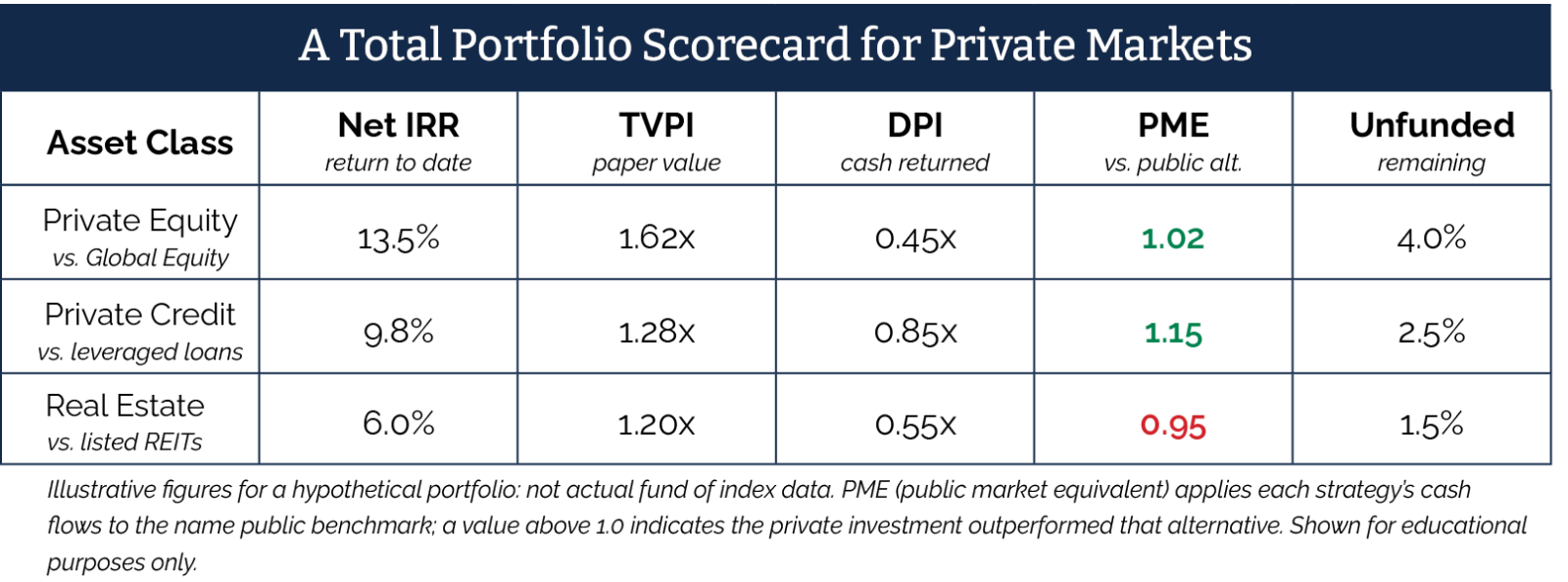
Seen through this lens, the current cycle is easier to interpret. In private equity, delayed exits can allow IRR and TVPI to look acceptable while DPI disappoints. That does not mean the value is false; it means liquidity is doing more work than the headline admits. Time is a cost even when no one invoices for it. The right question is whether the plan is being paid enough for the time and forgone alternatives.
Private credit deserves the same discipline. It is not immune to poor underwriting, aggressive structures, or sector stress. But its return engine is different. An equity owner holds a claim on an uncertain future; a lender holds a schedule of payments, and that schedule is observable through non-accruals, realized losses, and payment-in-kind income. The Cliffwater Direct Lending Index returned 9.3% in 2025, with income as the primary driver and credit-health measures described as steady or improved.1 Over two decades, it has averaged about 9.5% a year, with one down year. An income-driven return stream also tends to move differently from equities. Academic work analyzing 476 private-credit funds in the Burgiss database (Munday, Hu, True, and Zhang) reached a similar conclusion: performance matched or beat leveraged-loan, high-yield, and BDC benchmarks, with direct lending standing out.2 That does not end diligence, but it gives trustees better evidence than headlines alone.
The discipline cuts both ways, and the risk statistics deserve the most scrutiny. Because private holdings are marked by appraisal rather than daily trading, reported volatility can be artificially smooth, which flatters Sharpe ratios and depresses measured correlations, making a private strategy look more diversifying than the underlying economics warrant. The honest response is to adjust: de-smooth returns before computing volatility, and treat a low correlation as a hypothesis to test, not a feature to market. PME can likewise be skewed by an easy benchmark, and fees can absorb much of the gross advantage. A strategy that survives these adjustments has earned its place; one that looks good only before them has not.
For a mid-market plan, the agenda is straightforward: report IRR, TVPI, DPI, and unfunded commitments together; add a public-market reference to every review; treat reported volatility and correlation as figures to adjust, not accept; and ask what public exposure each private dollar displaced. The goal is not to make private markets look better or worse. It is to make them harder to misunderstand.
Chris Lund is a Partner and Portfolio Manager at Monroe Capital, where he focuses on institutional direct lending strategies across the U.S. middle market. He has over 15 years of experience in private credit, with a focus on portfolio construction, credit selection, and risk management. Mr. Lund has written and spoken on private credit, alternative investments, and the role of income-oriented strategies in institutional portfolios. He holds a B.A. from the University of Notre Dame.
Endnotes:
- Cliffwater Direct Lending Index (CDLI) 2025 Results
- Munday, Shawn; Hu, Wendy; True, Tobias; Zhang, Jian. “Performance of Private Credit Funds: A First Look.” The Journal of Alternative Investments (2018).
Disclosures: This article is for educational purposes only and does not constitute investment, legal, tax, or fiduciary advice. The views expressed are those of the author and may not reflect the views of any employer or affiliated organization. Past performance is not indicative of future results.