
2026 Pension Lab: NextGen Competition Showcases New Solutions for Public Pension Funding
By: Lizzy Lees, Director of Communications, NCPERS
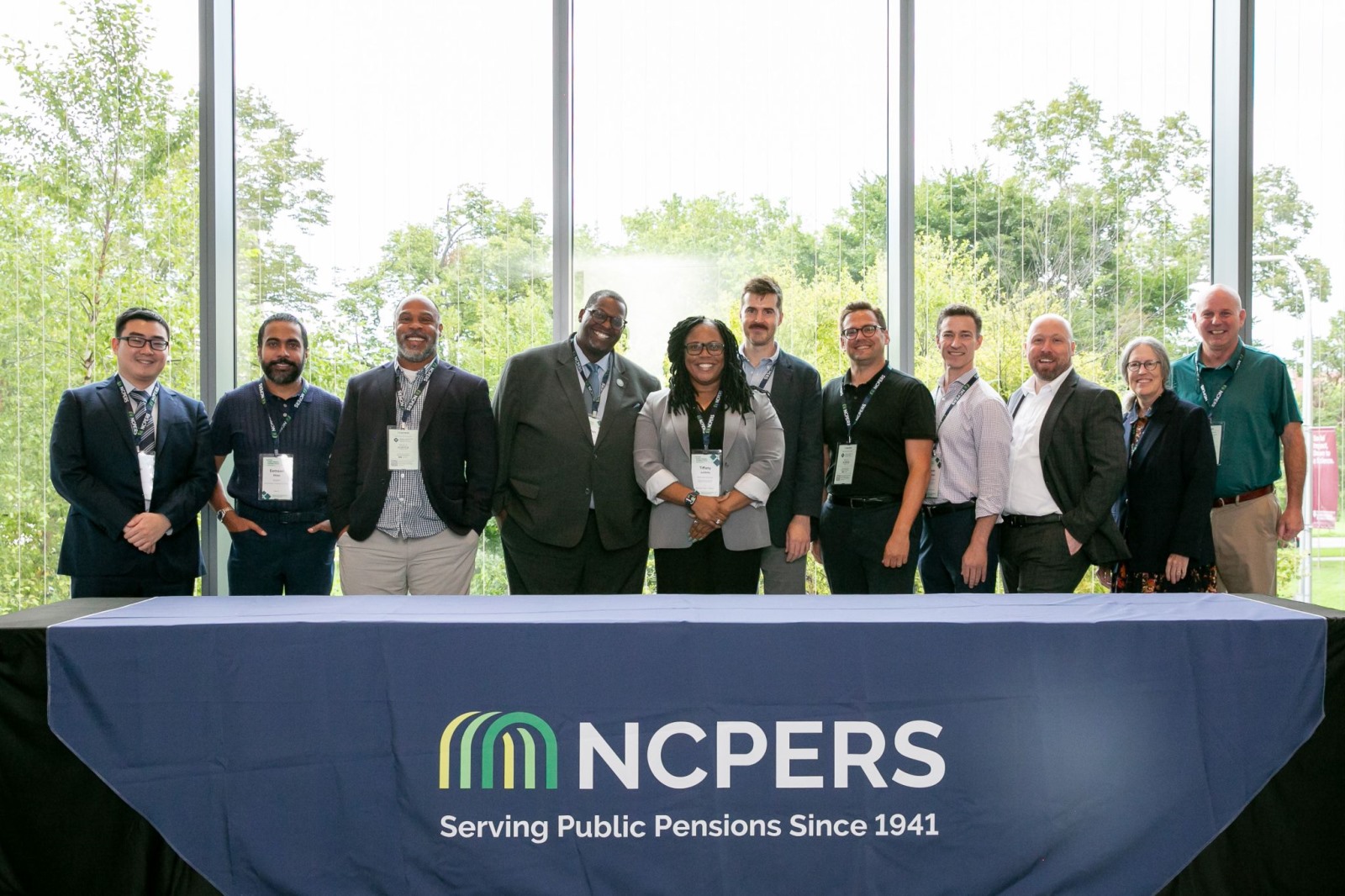
The future of public pensions depends on fresh thinking, rigorous analysis, and a willingness to tackle complex challenges with new perspectives. Those qualities were on full display last month at the 2026 Pension Lab: NextGen Competition, where graduate students from the Harris School of Public Policy at the University of Chicago presented original research and policy recommendations aimed at strengthening the sustainability of public retirement systems.
Developed through a partnership between NCPERS and the University of Chicago Harris School of Public Policy, the competition challenges students to develop innovative, policy-driven solutions to real-world pension funding issues. Throughout the process, students work closely with public pension leaders, refining their ideas through the lens of practical implementation, fiscal responsibility, and political feasibility before presenting them in a live competition at the Public Pension Funding Forum.
This year’s competition showcased four distinct approaches to some of the most pressing issues facing pension systems today, from investment performance and contribution policy to funding volatility and structural reform.
Team 1: Does Bigger Mean Better? The Size Effect in Public Pension Funds
Team Members: Prerna Panda, Neelima Raheja, and Vickie Siyu Zou
Mentor: Tiffany Junkins, Municipal Employees’ Annuity and Benefit Fund of Chicago
Large public pension funds are often assumed to have a performance advantage because of their scale and access to sophisticated investment opportunities. Team 1 set out to test that assumption by examining whether larger funds consistently generate stronger risk-adjusted returns.
Their research found that much of the perceived size advantage can be linked to exposure to alternative investments and the accompanying illiquidity risk. Once those factors are taken into account, the apparent performance premium largely disappears. The findings offer a fresh perspective on how pension systems evaluate investment performance, risk, and the role of scale in long-term portfolio success. Read the research brief.
Team 2: Chicago Pension Turnaround Proposal
Team Members: Noah Blaser and Melinda Wang
Mentor: Kevin Reichart, Policemen’s Annuity & Benefit Fund of Chicago
Focusing on one of the nation’s most closely watched pension challenges, Team 2 developed a multi-stage proposal aimed at improving Chicago’s pension outlook through greater transparency, stronger accountability measures, and targeted state action.
By implementing settlement accountability reforms for the Chicago Police Department, the team projects between $135 million and $210 million in annual savings that could be used to fund pensions. These reforms would help build public trust and fiscal credibility.
The presentation highlighted the difficult tradeoffs that policymakers face and offered a framework designed to balance fiscal realities with retirement security commitments. Read the research brief.
Team 3: An Automatic Pension Stabilizer: Making Pension Funding as Binding as the Pension Promise
Team Members: Agustín Duarte Baracat, Eemaan Khan, Yukun “Daniel” Lu, and Lekakeny Ole Rumpe
Mentor: Alex Li, State of Wisconsin Investment Board
Could pension funding become more predictable by reducing reliance on political decision-making?
Drawing inspiration from the Wisconsin Retirement System, the Canada Pension Plan, and Dutch models, Team 3 proposed a rules-based contribution mechanism that automatically adjusts contributions based on a plan’s funding status and financial conditions. Their approach seeks to create a more disciplined and transparent funding framework while helping pension systems avoid delays in addressing emerging funding challenges.
By reducing reliance on discretionary funding decisions, the proposal seeks to strengthen funding stability, improve transparency, and help pension plans respond more effectively to changing economic conditions while maintaining a clear commitment to retirement security. Read the research brief.
Team 4: Breaking the Procyclical Trap (Winning Proposal)
Team Member: Jason (Zezheng) Lin
Mentor: Mary Cahill, Illinois State Board of Investment
The 2026 competition’s top honor went to Jason (Zezheng) Lin for his proposal, “Breaking the Procyclical Trap.”
Lin’s research addressed one of the most persistent challenges in pension funding: the tendency for funding pressures to intensify during economic downturns, when governments often have the least fiscal capacity to respond.
His solution centered on a three-layer reform framework anchored by a Countercyclical Pension Stabilization Reserve. Using Monte Carlo simulations based on outcomes from the Illinois State Employees’ Retirement System (SERS), the analysis explored how reserve-based funding mechanisms could help pension systems better withstand economic fluctuations and maintain long-term funding discipline.
The proposal impressed judges and attendees alike by combining rigorous quantitative analysis with a practical framework that could help pension systems become more resilient across market and economic cycles. Lin ultimately took first place in the competition. Read the research brief.
Building the Future of Public Pension Leadership
Beyond the competition itself, the Pension Lab represents a broader investment in developing the next generation of public pension leaders.
By connecting graduate students with experienced practitioners, the NCPERS-Harris partnership creates opportunities for meaningful collaboration between academia and the pension industry. Students gain firsthand exposure to real-world funding challenges, while public pension professionals benefit from fresh perspectives and new ideas grounded in research and analysis.
NCPERS extends its appreciation to this year’s mentors, judges, and student participants for contributing their expertise, time, and creativity to the program. Their work reflects the spirit of innovation and collaboration that is essential to strengthening public retirement systems for future generations.
As public pensions continue to navigate evolving economic and fiscal challenges, the ideas presented through the Pension Lab demonstrate that the next generation of policy leaders is already helping shape the conversation.