
By the Numbers: Navigating the New SEC Landscape - What Institutional Investors Need to Know
By: Garrett J. Bradley, Guillaume Buell, Jamie E. Hanley, Domenico “Nico” Minerva, Carol C. Villegas, Mark S. Willis, Lisa M. Strejlau, Labaton Keller Sucharow LLP
This article discusses how the SEC’s shift toward reduced enforcement and constrained shareholder engagement tools affects institutional investors’ fiduciary duties, risk management, and loss recovery strategies.
The SEC’s enforcement pullback in fiscal year 2025 marks a significant shift for institutional investors. With fewer regulatory actions and lower investor recoveries, investors can no longer rely on the SEC as the primary accountability and recovery mechanism. Private securities litigation and Delaware fiduciary duty actions are increasingly important tools for protecting portfolio value.
The Numbers Behind the Shift
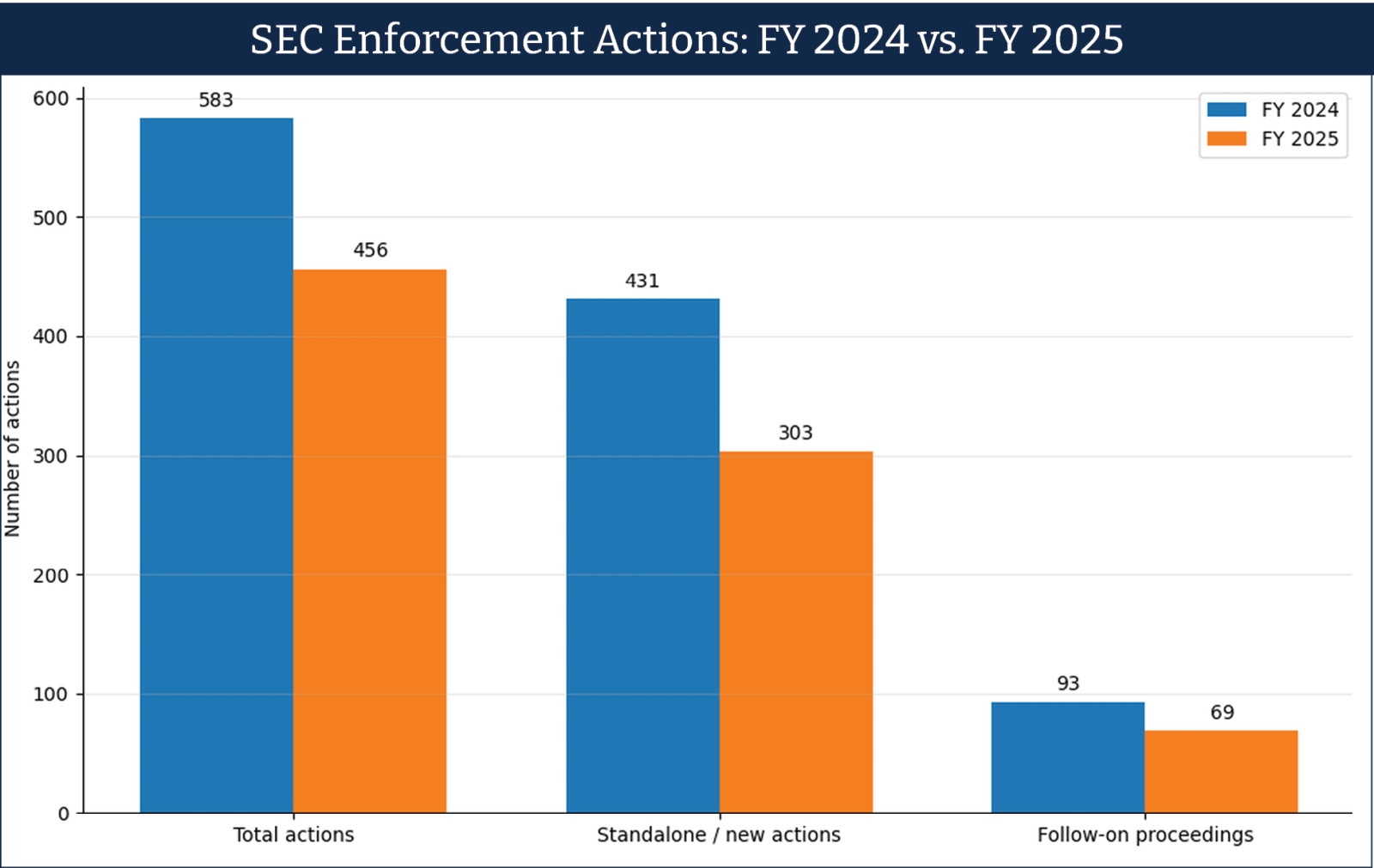
The SEC’s FY 2025 enforcement results confirm a substantial decline in activity. The agency filed 456 enforcement actions, down 22% from 583 in FY 2024, while standalone actions fell 30%, from 431 to 303.1
Although the SEC reported $17.9 billion in monetary relief, that figure was largely driven by a single $14.9 billion judgment tied to a long-running Ponzi scheme after more than 15 years of litigation.2 Excluding that outlier, recoveries were closer to $2.7 billion.
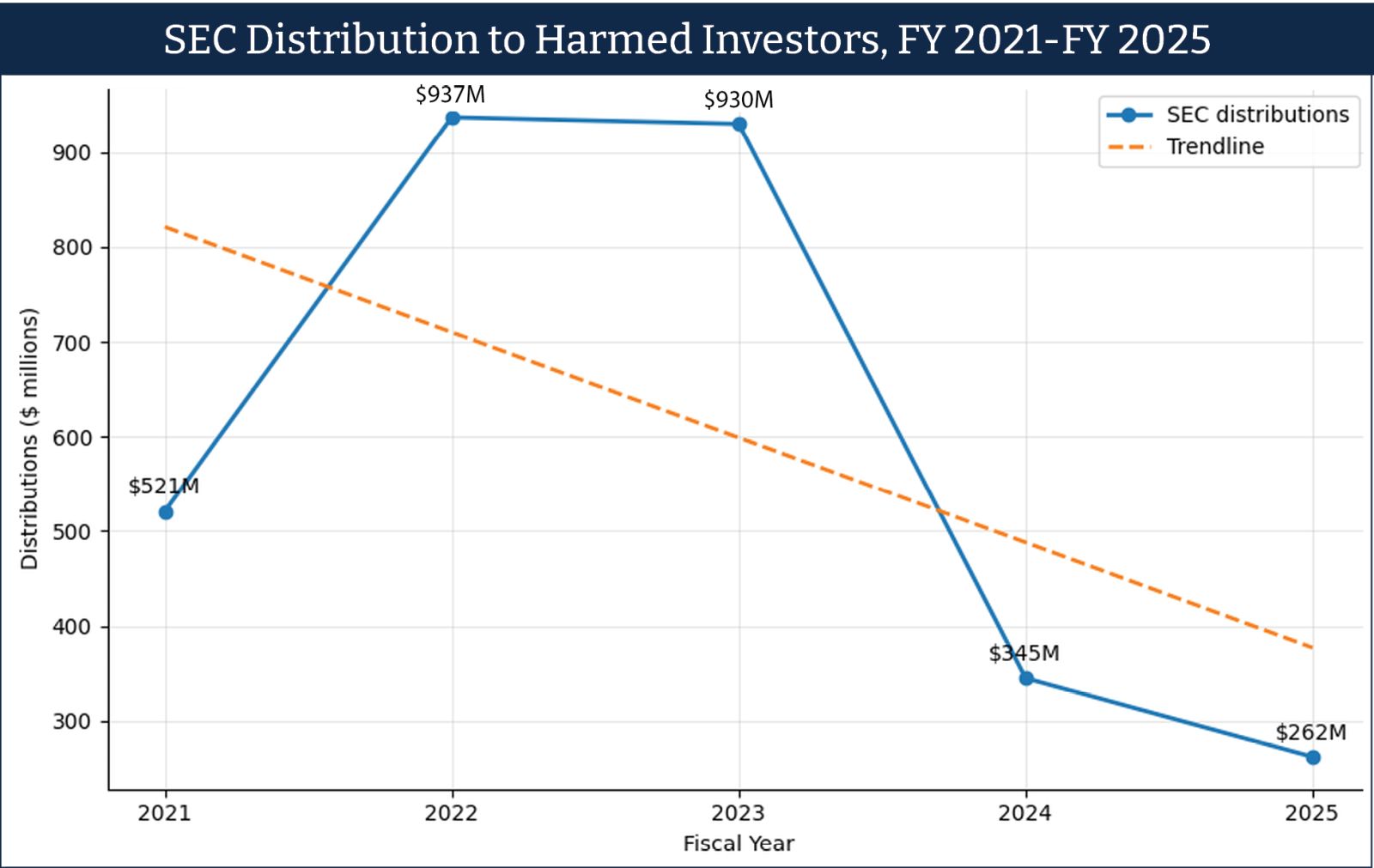
Most significantly, the SEC distributed only $262 million to harmed investors in FY 2025, down from $345 million in FY 2024 and the lowest level in five years.
Whistleblower awards also declined sharply. Despite a record number of tips, complaints, and referrals, the SEC awarded only $60 million to whistleblowers in FY 2025, compared to $255 million the prior year, potentially affecting the pipeline of fraud investigations that uncover significant investor harm.
Understanding the SEC’s New Priorities
SEC leadership has described FY 2025 as a deliberate shift away from “regulation by enforcement” with a narrower focus on fraud, market manipulation, and cases involving clear investor harm.
That shift is evident in the SEC’s treatment of prior enforcement priorities. The Commission has criticized them for producing substantial penalties without corresponding investor-protection benefits.
The SEC’s cryptocurrency approach has also evolved. While several crypto-related cases were dismissed, the agency created specialized units focused on cybersecurity, emerging technologies, crypto assets, and cross-border fraud.3
One exception is individual accountability. Approximately two-thirds of standalone cases involved charges against individuals, and the SEC imposed 119 officer-and-director bars in FY 2025. When the agency acts, executives increasingly face personal consequences.
Shareholder Engagement: Fewer Channels, Higher Stakes
While enforcement activity has declined, shareholder engagement tools have also become constrained. Recent SEC guidance has expanded the grounds for excluding shareholder proposals and reduced SEC involvement in no-action request disputes, making traditional governance channels more challenging.4
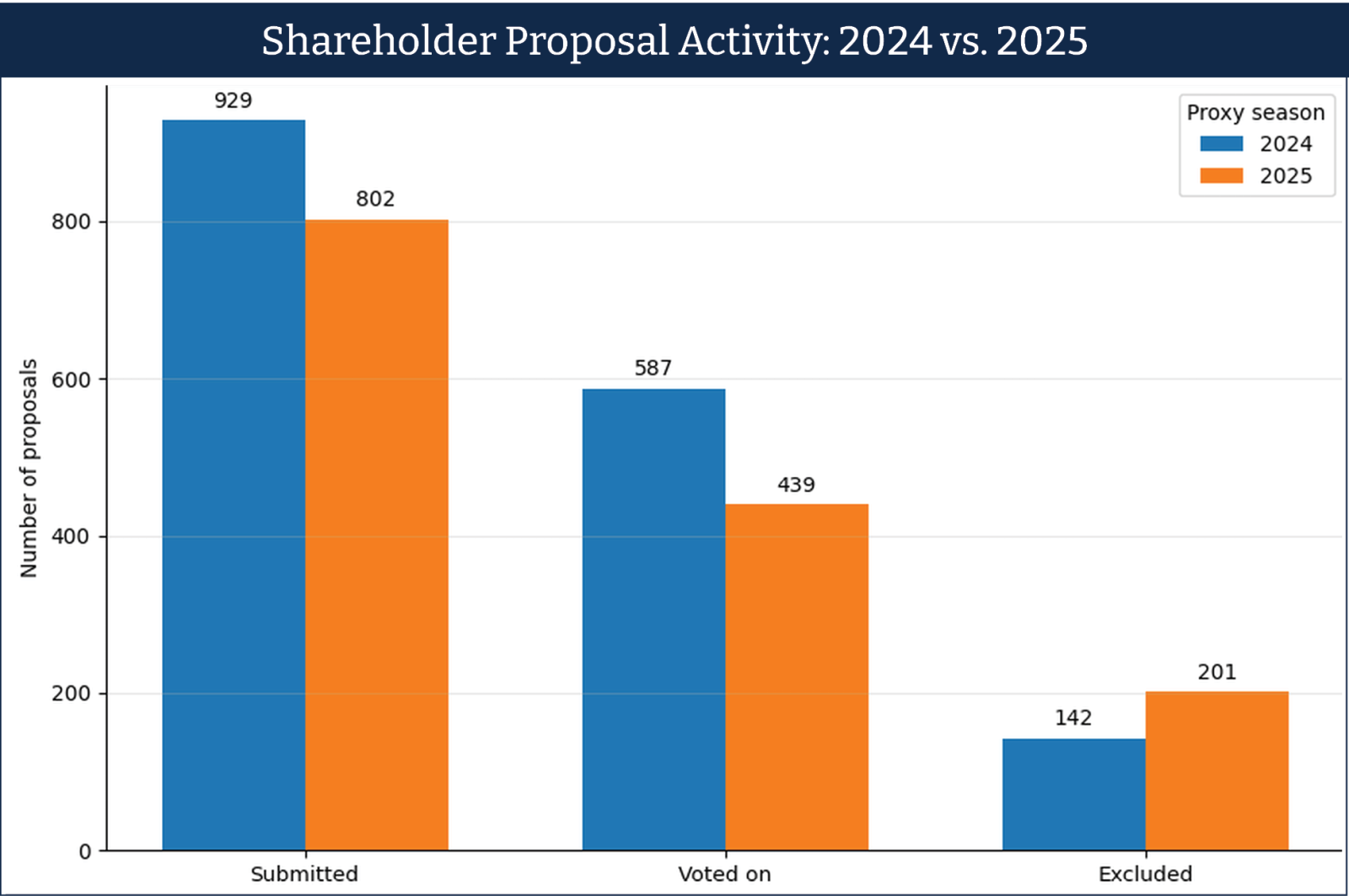
The data reflects this trend. In 2025, fewer shareholder proposals were submitted or reached a vote, while more were excluded.5 For many institutional investors, litigation is increasingly the primary accountability mechanism when engagement fails.
Private Litigation Is Filling the Gap
As SEC enforcement wanes, private securities litigation has become the principal avenue for recovering losses and addressing corporate misconduct.
Although securities class action filings declined modestly in 2025, case size increased dramatically. Disclosure Dollar Loss reached a record $694 billion, Maximum Dollar Loss rose to $2.862 trillion, and median settlements reached their highest level in nearly a decade.
Private litigation is also adapting to emerging risks. Courts are seeing more claims involving artificial intelligence disclosures, “AI-washing,” and other technology-related misrepresentations as companies face greater scrutiny over AI-related statements.
Delaware courts remain critical to shareholder protection, reinforcing investors’ ability to enforce merger agreements, obtain books and records, and pursue fiduciary-duty claims for information, accountability, and governance reforms.
The message is clear: investors cannot rely solely on the SEC for loss recovery or corporate deterrence. Proactive engagement with private litigation channels is now essential.
Strategic Considerations for Institutional Investors
This environment requires a more proactive approach to risk management and recovery:
- Prioritize portfolio monitoring to identify potential recovery opportunities early.
- Act quickly when losses emerge, preserving rights in both securities and Delaware actions.
- Monitor emerging risks, particularly AI-related disclosures and technology-driven business claims.
- Use litigation strategically to pursue governance reforms and hold boards and executives accountable when traditional engagement channels are unavailable.
Garrett J. Bradley is a Partner in the New York office of Labaton Keller Sucharow LLP. Garrett has decades of experience helping the country’s largest public pension funds recover losses attributable to corporate fraud. A former state prosecutor, Garrett has been involved in hundreds of securities fraud class action lawsuits that have, in aggregate, recouped hundreds of millions of dollars for investors.
Guillaume Buell is a Partner in the New York office of Labaton Keller Sucharow LLP. He is an experienced and trusted advisor to public pension funds regarding global securities litigation, corporate governance matters, and shareholder rights. As part of the Firm’s Non-U.S. Securities Litigation Practice, Guillaume also serves as liaison counsel to institutional investors in select overseas matters.
Jamie E. Hanley is the Partner-in-Charge of the London office of Labaton Keller Sucharow LLP and a member of the Firm’s Client Development and Case Evaluation Groups. An accomplished litigator with more than 25 years of experience in the UK, Jamie’s practice focuses on international securities and shareholder rights litigation, as well as advancing corporate governance reforms.
Domenico “Nico” Minerva is a Partner in the New York office of Labaton Keller Sucharow LLP. A former financial advisor, his work focuses on securities and shareholder derivative litigation, representing leading public pension funds across the world on issues related to corporate fraud in the U.S. securities markets.
Carol C. Villegas is a Partner in the New York office of Labaton Keller Sucharow LLP. Carol leads one of the Firm’s Securities Litigation teams prosecuting complex securities fraud and cases on behalf of public pension funds. Carol’s development of innovative case theories in complex cases, her skillful handling of discovery work, and her adept ability during oral arguments has earned her accolades as one of the “top Securities Litigators” in the country.
Mark S. Willis is a Partner in the Washington, D.C. office of Labaton Keller Sucharow LLP. With more than three decades of experience, Mark heads the Firm’s Non-U.S. Securities Litigation Practice advising leading pension funds around the world on their legal remedies when impacted by securities fraud and corporate governance breaches.
Lisa M. Strejlau is an Associate in the New York office of Labaton Keller Sucharow LLP. Her practice focuses on securities litigation and corporate governance and shareholder rights matters representing public pension funds in domestic securities actions nationwide.
Endnotes:
- SEC Announces Enforcement Results for Fiscal Year 2025, SEC (Apr. 7, 2026), available at (https://www.sec.gov/newsroom/press-releases/2026-34); Key highlights from the SEC 2024 enforcement report, Baker Tilly (Jan. 21, 2025), available at (https://www.bakertilly.com/insights/key-highlights-from-the-sec-2024-enforcement-report).
- SEC’s Enforcement Division Issues 2025 Report That Shuns Knuckleballs and Embraces Down-the-Middle Fastballs — and Brings In Woodcock as a Reliever, Debevoise & Plimpton (Apr. 8, 2026), available at (https://www.debevoise.com/insights/publications/2026/04/secs-enforcement-division-issues-2025-report-that).
- SEC Announces Cyber and Emerging Technologies Unit to Protect Retail Investors, SEC (Feb. 20, 2025), available at (https://www.sec.gov/newsroom/press-releases/2025-42); SEC Crypto 2.0: Acting Chairman Uyeda Announces Formation of New Crypto Task Force, SEC (Jan. 21, 2020), available at (https://www.sec.gov/newsroom/press-releases/2025-30); SEC Announces Formation of Cross-Border Task Force to Combat Fraud, SEC (Sept. 5, 2025), available at (https://www.sec.gov/newsroom/press-releases/2025-113-sec-announces-formation-cross-border-task-force-combat-fraud).
- Preparing for Your 2025 Form 10-K and 2026 Proxy Season, K&L Gates (Jan. 13, 2026), available at (https://www.klgates.com/Preparing-for-Your-2025-Form-10-K-and-2026-Proxy-Season-1-12-2026).
- Shareholder Proposal Developments During The 2025 Proxy Season, Harvard Law School Forum on Corporate Governance (Aug. 30, 2025), available at https://corpgov.law.harvard.edu/2025/08/30/shareholder-proposal-developments-during-the-2025-proxy-season/).