From AI Governance to Funding Policies: How Segal Supports Today’s Public Pension Leaders
By: Lizzy Lees, Director of Communications, NCPERS
Segal's Scott Miller and Brad Ramirez sat down with NCPERS to discuss what public pension trustees need to know today: why AI governance can't stop at your office doors, how to oversee vendor use of AI, and what full funding means for contribution policy and continuing education.
Every industry has its jargon. Public pensions have enough acronyms to fill an entire board packet.
Fortunately, organizations like Segal have spent more than 80 years helping public pension leaders cut through the complexity. While the firm’s foundation was built on actuarial expertise, today’s Segal advises retirement systems on everything from governance and administration to technology modernization and AI strategy.
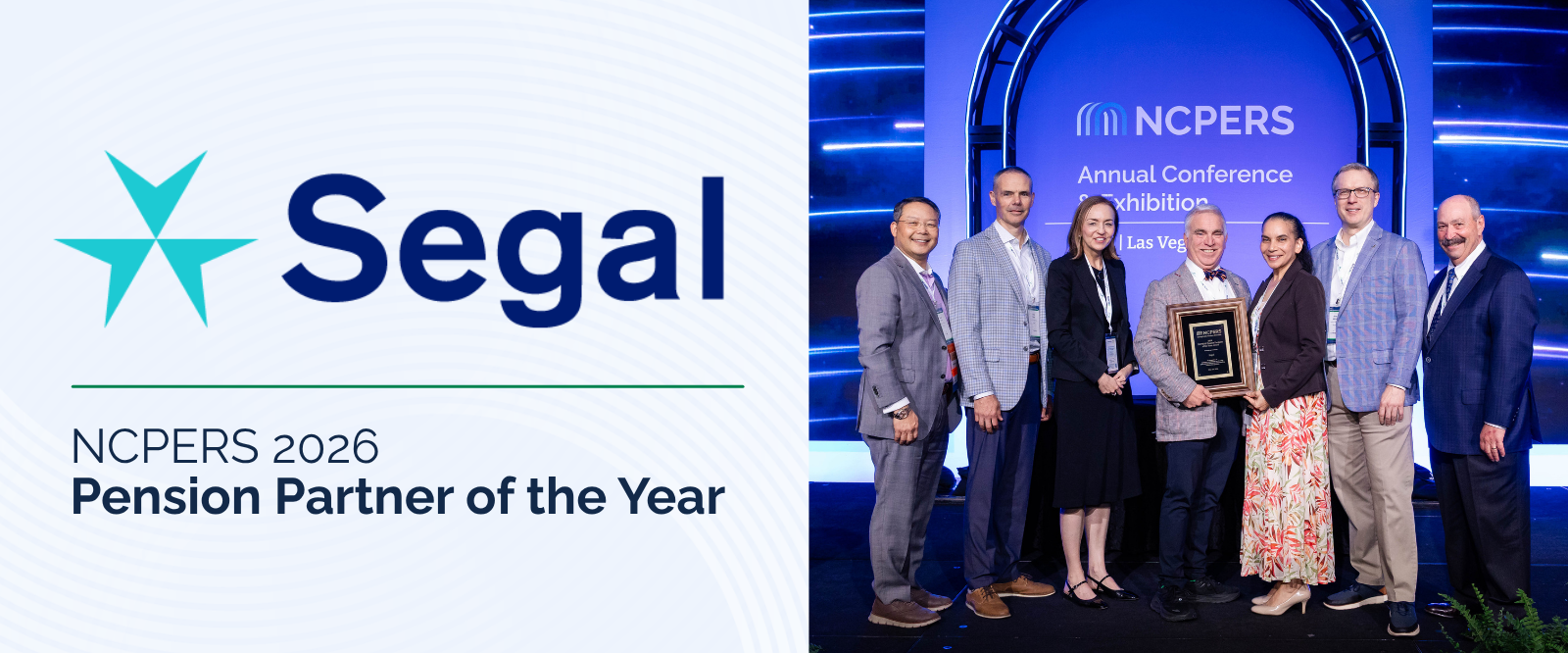
As the recipient of the NCPERS 2026 Pension Partner of the Year Award, Segal exemplifies how trusted partners continue to evolve alongside the public pension community they serve. We sat down with Scott Miller and Brad Ramirez to discuss the trends shaping the industry today, from funding levels to fiduciary best practices.
Tell us about your roles at Segal and the work you do with public pension systems.
Scott Miller: I’m a Senior Consultant in Segal’s Administration and Technology Consulting Practice (ATC). ATC provides a wide range of consulting services to public pension systems and other plan sponsors, including PAS implementation oversight, executive searches, and AI consulting. Because of my history as a public pension attorney and director, I’ve had the pleasure of working with several ATC clients on fiduciary and governance projects. I’m currently revising governance documents for a client on the West Coast. Later this year, I’ll work with their board on a self-evaluation project.
I have had relationships with several of the public pension trade organizations over the years, including NCPERS, and have been honored to speak at many of their conferences. Maintaining the friendships I’ve made at these conferences over the years and making new connections has been one of the most rewarding aspects of my role at Segal.
Brad Ramirez: I’m a Consulting Actuary with Segal’s Retirement Practice, primarily working with defined benefit plans in the public sector. My work generally involves helping these systems achieve their goal of providing reliable and meaningful benefits to their members. This involves constructing and maintaining funding policies, working with elected officials to advocate for sound public sector legislation and providing education to boards and staffs.
I help educate leaders of public pension systems by speaking at industry conferences, including NASRA, NCTR and NCPERS.
Public pension trustees today face increasingly complex decisions involving investments, funding, technology, and governance. How can continuing education help boards navigate these challenges?
Brad Ramirez: In the actuarial world, education is vital. Trustees need not understand every number in an actuarial valuation report but they should have enough background to ask questions about liabilities, contributions and actuarial smoothing. If your actuary says something you don’t understand, just ask! It’s our job to help you understand actuarial concepts so you can fulfill your duties and make informed decisions.
Scott Miller: The duty of prudence that applies to every trustee requires them to become knowledgeable on the topics before them so they can make prudent decisions.
Although that knowledge can come from experts, trustees must have a baseline understanding sufficient for them to oversee and evaluate the information they receive from those experts. Continuing education helps establish and build on that foundation. Put simply, continuing education is necessary for trustees to fulfill their fiduciary responsibilities.
Many public pension plans are in a stronger funding position now than they were a decade ago. What factors have contributed to that progress?
Brad Ramirez: In the aftermath of the Great Recession, many systems had to make difficult choices in order to balance the promises of their plans with expected contributions and assets on hand. In nearly every jurisdiction, we’ve seen some form of pension reform involving benefit adjustments and contribution increases.
Not only are plans generally better funded than they have been in many years, but the assumptions they use to calculate their contributions are more conservative than ever. Plans are being exposed to much less investment and mortality risk than in previous years. As a result, many systems can see a clear path to a state of full funding, where the unfunded liabilities of the plans will be entirely paid off.
As plans move closer to full funding, how should boards think about balancing contribution discipline, investment risk, and long-term sustainability?
Brad Ramirez: Being at or near a full funding position provides a unique set of challenges. Most importantly, the disappearance of large amortization bases can result in significant contribution volatility. To deal with this, we’ve worked with some clients to develop a “glide path” that systematically winds down contributions over an extended period to balance contribution relief and plan sustainability. It’s important to have those conversations sooner rather than later so that a contribution strategy can be put in place well in advance of this volatility.
There may also be challenges politically. As we learned in the late 1990s, plans reaching a full funding position faced pressure to increase benefits, erasing surpluses that would have been effective in calming volatility in the rough asset years that soon followed. Policy decisions about benefit improvements and contribution decreases must be made mindfully and that the associated risks should be carefully considered.
What practical AI use cases are you seeing emerge in pension administration and board operations?
Scott Miller: Initially, I should note that the most successful AI use cases we are seeing are not trying to use AI to replace people or make fiduciary decisions. Instead, they are helping staff work through growing administrative complexity more efficiently.
Organizations are using AI to help with document intake and review, extracting information from forms and correspondence, summarizing lengthy materials, supporting staff training and onboarding, and assisting member-service teams with finding and communicating information more consistently. Several public pension systems are exploring using AI to streamline internal workflows and reduce the time spent on repetitive administrative tasks.
For board and governance functions, the practical applications tend to be more straightforward. AI can help summarize board packets, draft briefing materials, identify action items, organize large volumes of information and improve trustee access to policies, reports and supporting documentation. The goal is not to automate judgment, but to support it by allowing boards and management teams to spend less time searching for information and more time discussing risks, strategy and oversight responsibilities.
The common thread is that the systems seeing the most value are treating AI as a productivity and knowledge-support tool rather than an autonomous decision-maker.
Human review, accountability, governance and fiduciary oversight remain essential.
Why is it important for pension systems to address AI governance now rather than later?
Scott Miller: System employees are already using AI frequently at both work and home. Two years ago, when I presented on this topic at the NCPERS Annual Conference, I cited a survey that found that 55% of employees had used unapproved generative AI tools at work. Recent surveys suggest similar statistics for non-executive employees, and even higher numbers for management and executive employees. Using AI tools without appropriate guiderails can compromise the security and integrity of system data.
But your AI governance efforts should not stop at your office doors. System vendors are also using AI, and it is the system’s responsibility to oversee vendor use of AI and ensure that use is reasonable and secure. Systems should understand what data is involved, what safeguards apply and whether the contract language supports appropriate oversight. Very few of the systems for which we have helped implement internal AI governance practices realized at the beginning of the project that they must also include vendor oversight. Systems are adept at requiring appropriate cybersecurity measures from their vendors, but few realize that their contracts should also include AI provisions.
Keep in mind that AI changes the economics of both productivity and risk. AI can lower the cost of scaling useful work, but it also lowers the cost of cybercriminal activity, including phishing, impersonation, social engineering and other malicious activities. Implementing appropriate AI governance practices before informal use becomes embedded in daily operations will help mitigate those risks.
What topics do you believe should be at the top of every trustee’s continuing education agenda over the next few years?
Scott Miller: As you might imagine from my earlier comments, there are two topics I think are essential for trustees. First, annual fiduciary training, which consists of understanding fiduciary responsibilities, provides the base that supports every decision a trustee makes. That is absolutely essential and is considered a best practice.
Second, understanding AI and how it can be effectively and safely incorporated into a system’s workload will benefit trustees and their systems. AI usage and the resulting risk are too widespread to ignore.
Brad Ramirez: Most trustees and consultants have spent our careers working toward improved funding positions for retirement plans, and we’re starting to arrive at the place where that hard work has paid off. The work isn’t done, however. The ongoing challenge will be to maintain the balance between contributions made and the benefits that members receive and appreciate. Education in what full funding means (and what it doesn’t mean), how actuarial contributions are developed and alternatives to smooth contribution volatility will be vital in the coming years.