
The Limits of Knowledge and Financial Trust
By: Thomas Anichini, GuidedChoice/3Nickels
While AI can improve planning through data analysis, risk monitoring, and operational efficiency, it cannot overcome the fundamental uncertainty of investing or reliably predict the future. Because of these technological limits, core investment practices such as diversification, rebalancing, and human oversight will continue to be essential even as AI tools become more sophisticated.

In my Spring article, How Could AI Help Public DC Plans?, I wrote that AI could help HR staff identify members who face a higher risk of making avoidably poor financial decisions. Plans can use behavior markers to flag those risks, and AI can help plans run systems to monitor them better.
This article makes a related point: even as AI tools improve, investing remains governed by uncertainty.
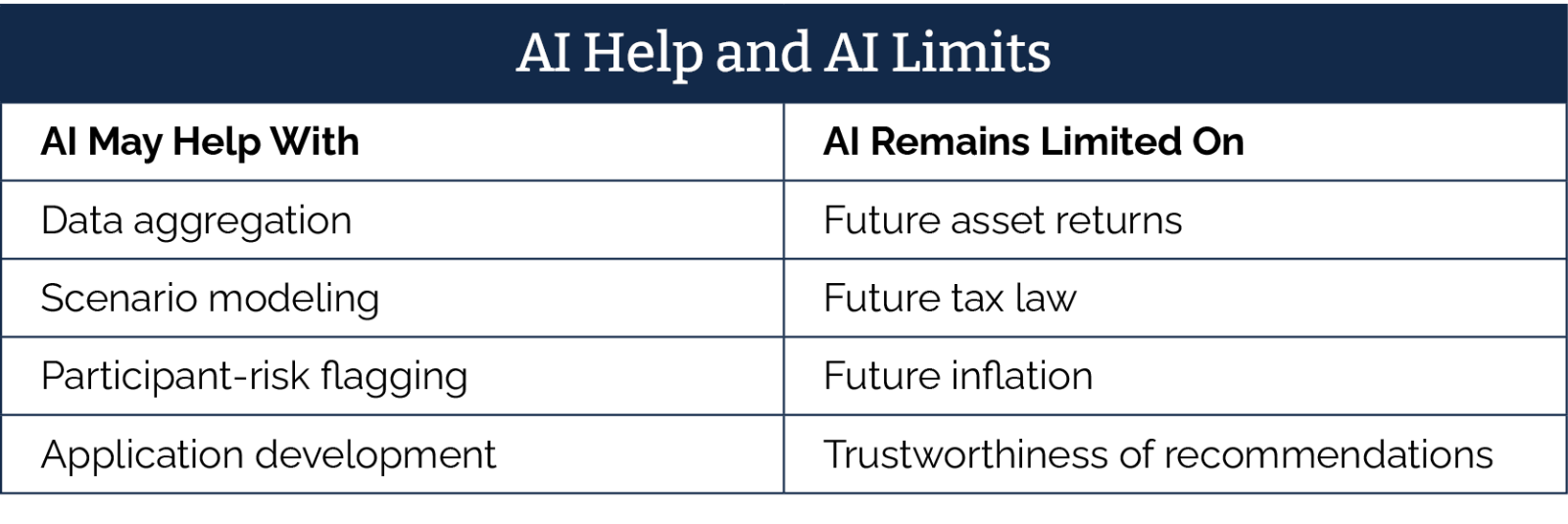
The limits of knowledge explain many of the best practices in retirement investing. In investing, the phrase “limits of knowledge” refers to the fact that we cannot know future returns, tax rates, inflation, interest rates, and participant behavior with certainty. Because we do not know what markets will do, we set reasonable expectations. We expect volatility. We diversify. We rebalance. We repeat the process.
Recently, an undergraduate asked whether, since AI’s basic skill is prediction, we might soon turn on an AI system and let it invest for us. That question is useful because it separates prediction from certainty.
AI may improve data processing, pattern recognition, and operational efficiency. While AI might assist in diversifying, rebalancing, etc., those practices remain necessary because the future remains unknown, even to AI.
Suppose an AI knew the future. Investors would not need diversified portfolios. They would not need rebalancing rules. They would not need Monte Carlo simulations or scenario planning. They would simply buy the asset that would perform best.
But if everyone used the same AI, everyone would know the same future. Everyone would try to buy the same winning asset and avoid the same losing assets. At that point, the trade breaks down. For every buyer, there must be a seller. If no one holds the opposite view, no one can capture the benefit.
AI may predict many things, but future asset prices remain an elusive target. Even high-frequency traders, whose algorithms react faster than humans can, exploit prediction advantages measured in milliseconds, not in minutes or hours. They cannot predict whether the market will finish up or down today, never mind this week or this year.
AI also will not know future tax rates, future inflation, future interest rates, or future bond yields. It can process data and news faster than people can. It can help traders and fiduciaries respond to changing conditions. But it cannot know the future conditions that matter most; thus humans must remain involved.
Experienced people must still set expectations, choose portfolio structures, define rebalancing rules, and design glidepaths. Those people will use more AI tools over time, and they should. But the limits of knowledge still apply.
Easy-to-Build Apps Still Need Review
AI gives rise to a second problem when it comes to retirement advice: It makes software easier to build than to trust.
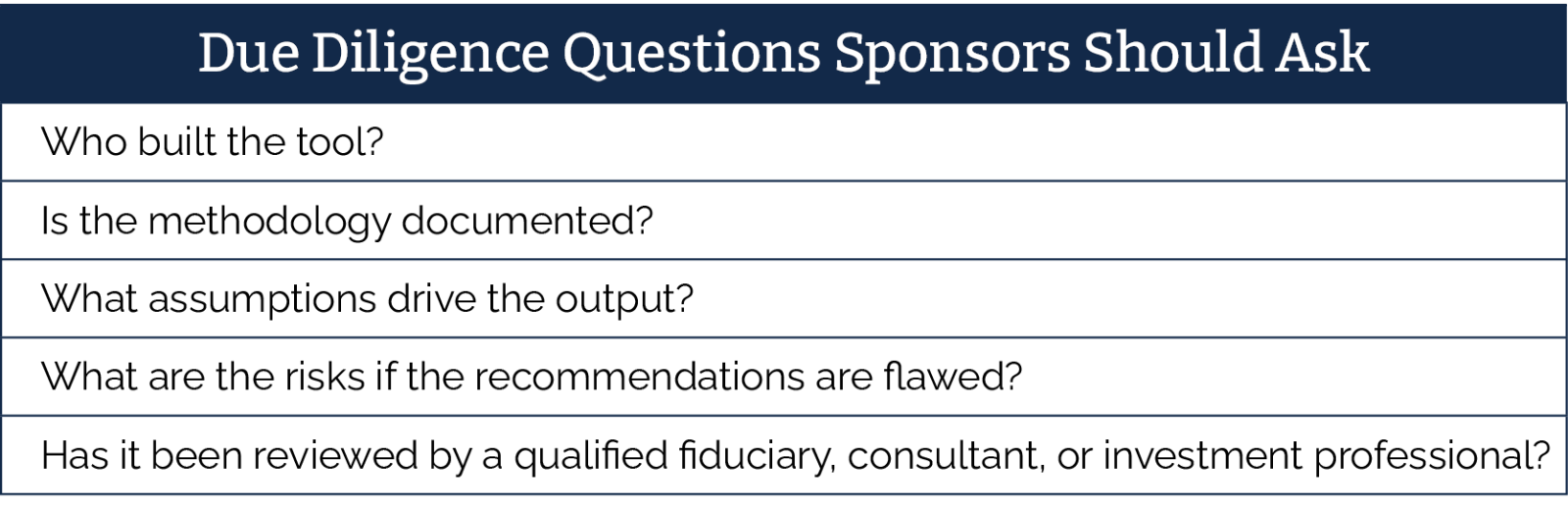
I recently came across a comparison of different apps built to model Roth conversions. At first glance, all the apps seem thorough. At least one was built by only one person; that one and presumably many of the others were built with Codex, Claude Code, or the like. But just as AI makes it easier for experienced developers to create software quickly, it also makes it easier for novices. This gives rise to an ever-growing supply of apps from which to choose, making it more of a burden to discover which advice engines are sound.
If Codex and Claude Code equip almost anyone to build decent-looking financial apps easily, how do you decide which apps deserve your trust? Plan sponsors need a process for reviewing and documenting whether tools are appropriate.
Humans Needed
AI may expand what public plan sponsors and their vendors can analyze, but it will not eliminate uncertainty. Plans need policies for governing AI-supported tools and competent humans to determine whether to trust the tools’ answers.
Thomas Anichini, CFA, CFP, is Chief Investment Strategist with GuidedChoice/3Nickels, with over 30 years of actuarial and investment experience.
Tom is a member of GuidedChoice’s Investment Committee. He refines GuidedChoice’s capital market assumptions and proprietary return model, and also contributes to GuidedChoice’s retirement advice engine and 3Nickels financial advice engine. Tom communicates about the firm’s philosophy and advice, and represents the investment team when facing clients and consultants.
Tom is also a Lecturer in Finance for the College of Business Administration at the California State University at San Marcos.