
Total Portfolio Approach and Strategic Asset Allocation: Governance, Trade-Offs, and Considerations
By: Tom Toth, Wilshire
The Total Portfolio Approach (TPA) represents a shift from rigid asset allocation to a flexible, opportunity-driven framework that can improve agility and capital efficiency, but requires strong governance, culture, and investment capabilities to succeed.

As institutional investors navigate increasingly complex markets, the limitations of traditional Strategic Asset Allocation (SAA) are coming into sharper focus. The Total Portfolio Approach (TPA) represents a meaningful evolution — shifting emphasis from static asset buckets to a more flexible, opportunity-driven framework seeking to align capital allocation with total portfolio outcomes.
We explore the key distinctions between SAA and TPA, highlighting the governance, accountability, and execution trade-offs organizations must consider. While TPA offers potential for greater agility, clearer decision-making, and more efficient capital use, its success depends on the strength of governance, culture, and investment capabilities.
SAA vs. TPA
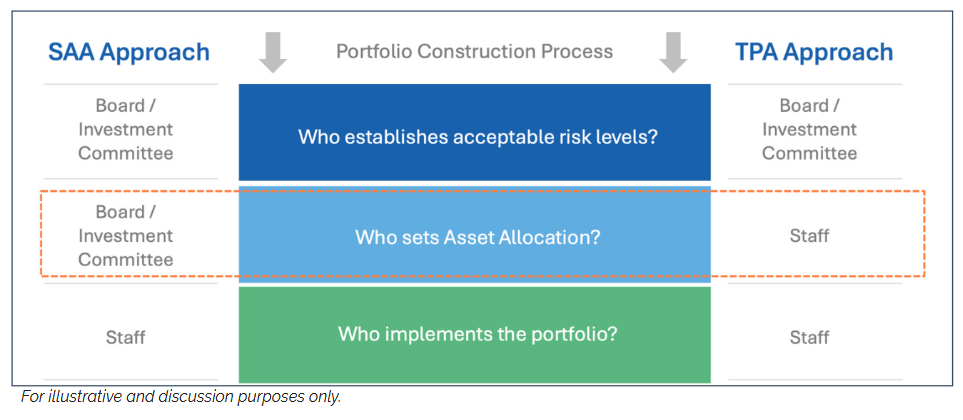
The Total Portfolio Approach is often described as an evolution of Strategic Asset Allocation, reflecting a shift toward more holistic portfolio management. Both frameworks share a common structure: boards determine risk appetite, and investment staff implements the portfolio. The key difference lies in who controls asset allocation. Under SAA, boards set fixed asset class targets and ranges. Under TPA, boards define risk through a Reference Portfolio and active risk limits, while staff dynamically allocates capital across opportunities.
This shift has three implications. First, greater agility — staff can adjust allocations in real time instead of following a rigid rebalancing cycle. Second, clearer accountability — staff are fully responsible for performance relative to the Reference Portfolio, eliminating ambiguity between board and staff roles. Third, capital allocation becomes merit-based, with each investment needing to exceed the opportunity cost of capital, rather than filling predefined asset buckets.
Potential Benefits of TPA
TPA can improve implementation efficiency by directing capital toward the most attractive opportunities rather than maintaining fixed allocations. While some evidence suggests higher returns, outcomes are not guaranteed and often depend on strong organizational capabilities.
Another advantage is agility, enabling faster responses to market changes. However, this flexibility only adds value if supported by high investment skill. TPA also encourages innovation, enabling strategies that cut across traditional asset class boundaries (e.g., multi-asset or relative value approaches).
TPA can also strengthen accountability. A single Reference Portfolio serves as the benchmark, making it easier to evaluate decisions consistently and transparently compared to SAA’s multiple benchmarks.
Cost and Risks of TPA
The transition to TPA requires significant changes in governance. Boards must be willing to delegate authority, and staff must demonstrate capability and integrity. This level of trust can be difficult in environments with political pressures, turnover, or competing priorities.
Cultural transformation is another hurdle. TPA requires investment professionals to think beyond asset class silos and understand total portfolio impacts. Collaboration, transparency, and cross-asset expertise become essential. Compensation and incentives must align with total portfolio outcomes rather than individual strategies.
TPA may introduce diversification constraints, as deviations from the Reference Portfolio — typically equity-heavy — can create tracking error, discouraging certain defensive strategies.
The approach also increases complexity, requiring advanced risk systems, real-time analytics, and integrated data across public and private assets. Without sufficient infrastructure and expertise, TPA can lead to poor decisions rather than better ones.
Finally, time and resources are significant considerations. Transitioning to TPA is a multi-year effort, often requiring organizations to maintain SAA while building new capabilities, placing strain on teams.
The decision is not whether TPA is inherently better than SAA, but whether an organization has the governance, talent, culture, and infrastructure to execute effectively. For many, a full transition may not be practical. Instead, adopting selected elements — such as a Reference Portfolio or greater flexibility — may offer a more achievable path along the spectrum between SAA and TPA.
Click here to read the full paper at the Wilshire website.
Tom Toth, CFA is a Managing Director at Wilshire heading Wilshire’s public pension vertical, providing client service for a variety of pension, endowment and foundation clients. He is a member of Wilshire’s Investment Strategy Committee which is tasked with analyzing and interpreting current market conditions to make informed decisions on asset allocation and investment strategies.
Disclosures: Wilshire Advisors LLC (“Wilshire”) is an SEC-registered investment adviser serving diverse institutional and intermediary clients. Wilshire’s products, services, and advice may differ among clients and may not be available to all investors. Information presented is for informational purposes only, does not constitute legal, tax, accounting, or investment advice, and is subject to change. Certain data has been obtained from third-party sources believed reliable, but accuracy is not guaranteed. Charts, forecasts, and projections are for illustrative purposes only and do not reflect actual or expected performance. Past performance is not indicative of future results. This material may include forward-looking statements which reflect Wilshire’s current views, involve risks and uncertainties,
and may change without notice. Reliance on such statements should be limited. For additional information, please review Wilshire’s ADV Part 2 at www.wilshire.com/ADV
Wilshire® is a registered service mark.
Copyright © 2026 Wilshire. All rights reserved.
M956938 E1026