As He Retires, LACERS CIO Rod June Reflects on the Evolution of Public Pension Investing
By: Lizzy Lees, Director of Communications, NCPERS
During the 2026 Chief Officers Summit, NCPERS presented a service recognition award to Rod June for his exceptional contributions to the public pension community.
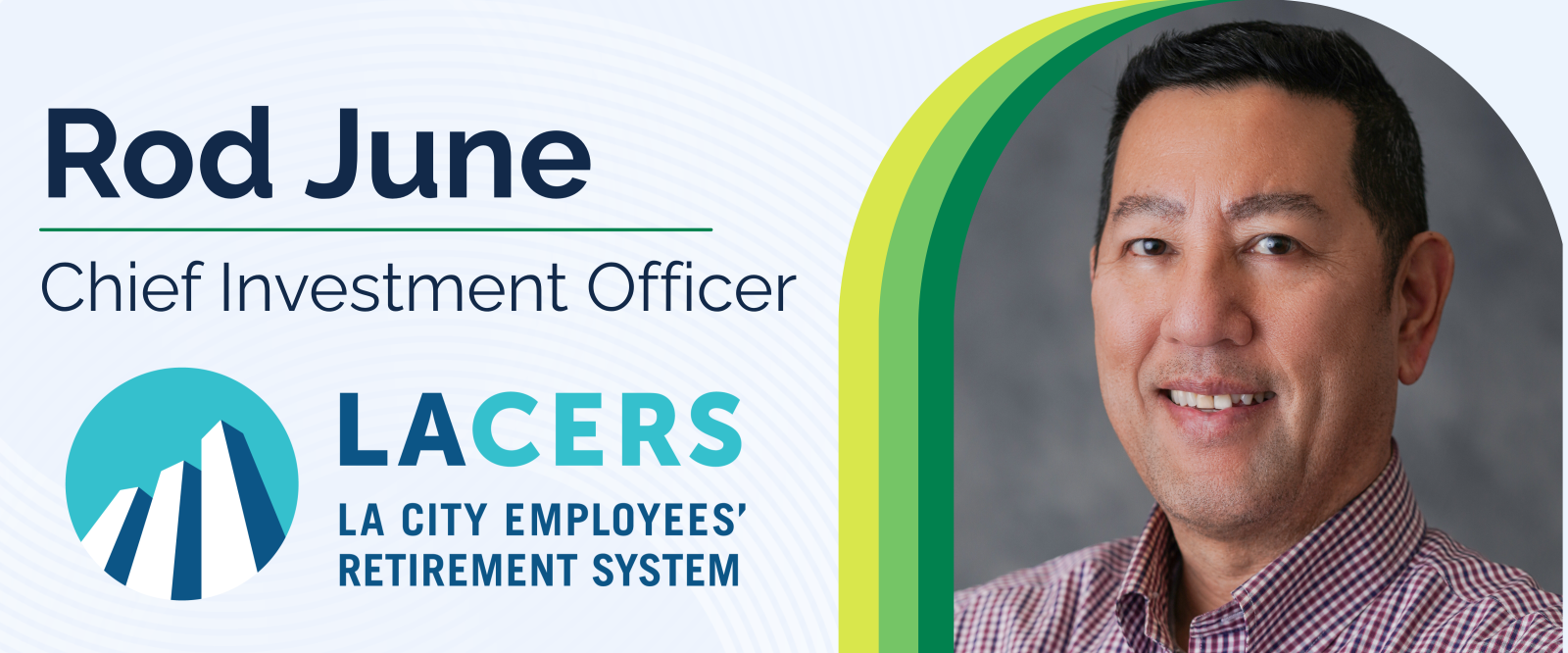
Throughout his career, he’s led with impact, vision, and a mission-driven mindset. After serving as an investment officer at LACERS for ten years, he became CIO for the state of Hawaii Employees Retirement System. He then returned to LACERS as CIO, overseeing the fund’s assets grow from $10.6 billion in 2012 to nearly $27 billion today.
When he spoke with NCPERS CEO Hank Kim nearly one decade ago, he helped plant the seeds of what evolved into the Chief Officers Summit. A true public servant, Rod volunteered as a program director each year since the summit was first held in 2017. In doing so, he’s helped fellow public pension executives continue to learn, grow, and collaborate as they navigate challenges and opportunities together.
After 24 years of dedicated service with LACERS, Rod is retiring from his role as CIO on July 11, 2026. He spoke with NCPERS about how he’s seen the public pension industry evolve, what advice he has for the next generation of pension executives, and more.
Over the course of your career, how have you seen the role of a public pension CIO evolve?
Rod June: When I first took the helm as a CIO at Hawaii ERS in early 2008, public pension plans continued to invest very closely to the traditional 60-40 allocation model since many held the belief of “if it ain’t broke, why fix it?”
Enter the Great Financial Crisis (GFC) when many public pension plans experienced deep losses due to heavy exposures in the public markets. CIOs were unsure of the appropriate block-and-tackle strategy. Many CIOs decided to largely follow their respective plan’s time-honored and tested asset allocation policy and let it do what it was designed to do: endure all weather and storms.
Whether that was the right or wrong call depends on many circumstances of that plan’s allocation policy. Following the painful aftermath of the GFC, CIOs began to question the value and relevance of traditional allocation models and began to explore and make policy adjustments – some small, some revolutionary.
For example, some consultants began pitching to their clients a restructuring of a plan’s assets by functional risk buckets and labeled them as such: risk, liquidity, risk-offset, inflation protection, etc. Some, like LACERS, developed more flexibility within their rebalancing policy and also created an opportunistic sleeve to take advantage of capital dislocations within the market. Other plans are now adopting a Total Portfolio Approach to provide greater flexibility in allocating capital in light of anticipated future market conditions.
With that said, CIOs need to continue to have nerves of steel to face great magnitudes of market gyrations while at the same time instill to their boards a sense of confidence and trust in the plan’s ability to endure and navigate the investment program through very rough conditions.
What was the biggest challenge you overcame as a public pension CIO?
Rod June: I feel the biggest challenge I overcame as a CIO was to practice the art of the possible with a “can do” attitude. This required being fearless of setbacks and failure and being receptive to change. To pursue real progress and achieve new levels of excellence, it is necessary to aim high by going beyond one’s comfort zone and steering away from the status quo when the global investment landscape moves faster than investment industry at large.
What advice would you give to someone stepping into a public pension executive role today?
Rod June: You are assuming a new role and identity as a leader in a very complex geo-political world. You must consciously work and practice to be a better version of yourself. Learn! Ask questions. Have curiosity. Be prepared to navigate an ever-changing landscape, to take calculated risks, and to confront the uncomfortable realities of a dynamic pension organization.
Find a seasoned mentor and a brutally honest professional coach. Your mentor should provide you with those “if I only knew then what I know now” moments. Your coach should be a key individual who will impart more immediately adoptable skills and offer honest behavioral reshaping to elevate you to the rank of leader.
I also recommend developing a strong network of smart people who you can rely on for help.
As a founding program director of NCPERS Chief Officers Summit, why do you think it’s important for pension executives to have collaborative spaces to learn together?
Rod June: It will sound cliché, but (with all honesty) we are only as strong as our weakest link. It is imperative that executives minimize or eliminate their professional blind spots. The NCPERS Chief Officers Summit provides that exact benefit through intensive but practical learning sessions led by their peers and industry experts in a non-threatening, non-judgmental, collegial environment. Key pension plan leaders who attend the Chief Officers Summit will be equipped to address complex issues within their organization and effectuate positive change in a meaningful way.
What accomplishment are you most proud of during your 24 years with LACERS?
Rod June: My most important contribution has been to strengthen the investment program through reshaping the investment policy. We’ve enhanced it to be nimble and more relevant in today’s increasingly complex investment landscape with the presence of sophisticated asset classes and strategies. I feel that continual improvement in such policies emphasize the quest to achieve the highest probability that long-term financial goals and objectives can be achieved.
And after years of working to ensure others have a secure future, how does it feel to be approaching your own retirement?
Rod June: I am pleased that I leave behind a path that is wider and more inclusive than the one I found. With that thought, I am excited about the next chapter of my life, which I hope to continue to build professional bridges for young, aspiring professionals and students from all backgrounds who are considering a career in the investment industry.