
Real Estate Private Debt: How a Research-Driven Approach Provides an Opportunity for Pensions
By: Daniel Savage, Peachtree Group
Understanding the intricacies of yield-focused real estate credit can help pension fund trustees and investment managers best serve the income and cash flow needs of their overall pension portfolio. This article outlines how investment committees can best determine whether real estate private credit supports portfolio objectives through a research-driven approach.

As pension funds navigate higher interest rates, market volatility, and growing pressure to meet long-term liabilities, real estate private debt has emerged as an increasingly attractive segment of alternative investments. Once viewed primarily as a complement to real estate equity, private debt is now being evaluated as a strategic source of income, downside protection, and diversification. For pension managers seeking stable returns in an uncertain environment, research-driven analysis is becoming essential to investment decision making.
Real estate private debt consists of non-publicly traded loans secured by commercial real estate assets, including senior mortgages, bridge loans, mezzanine financing, construction lending, and preferred equity structures. Unlike equity investments, which rely on appreciation and operating performance, debt investors receive contractual interest payments and benefit from collateral protection through their position in the capital stack.
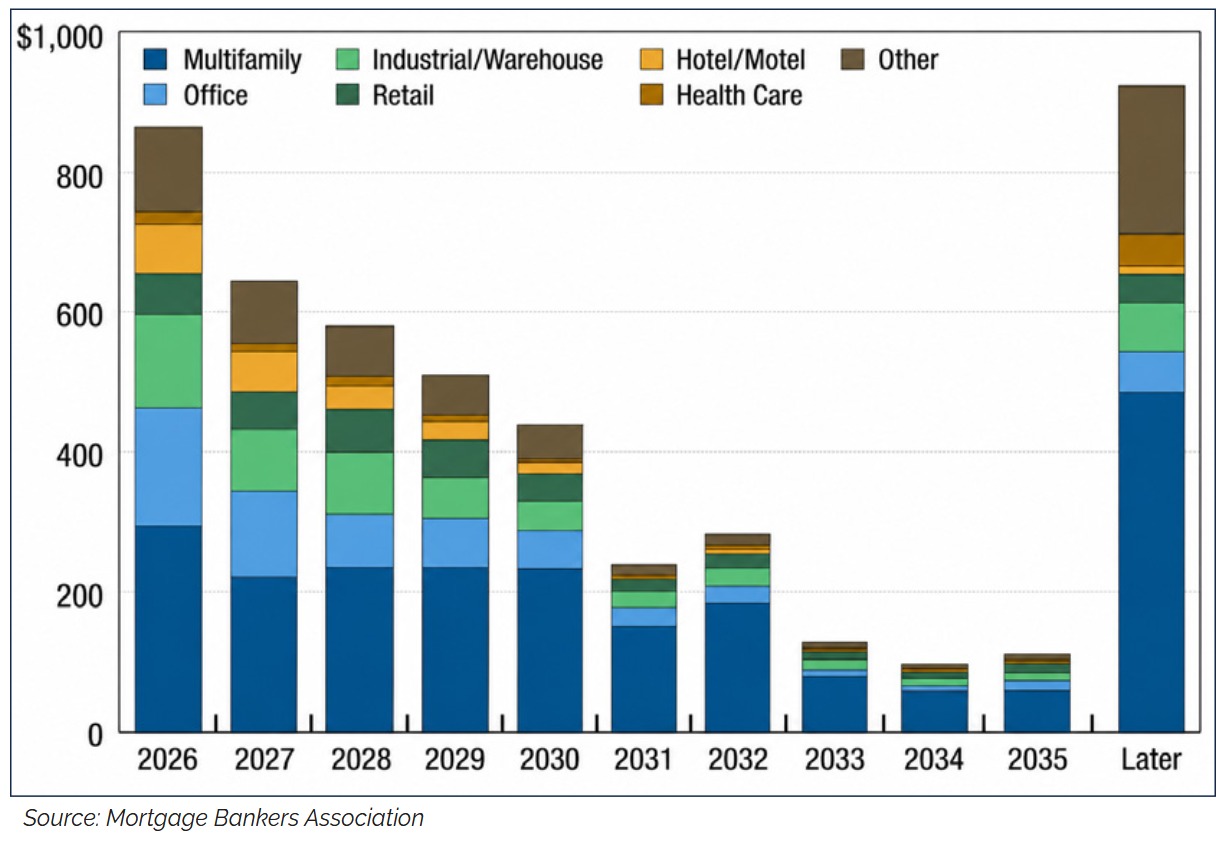
The growing interest in real estate private debt is driven by current market conditions. According to the Mortgage Bankers Association (MBA), approximately $875 billion of commercial and multifamily mortgage debt — roughly 17% of the $5 trillion outstanding market — is scheduled to mature in 2026. While down from approximately $957 billion in 2025, refinancing demand remains significant.1
At the same time, traditional lenders have become more selective. Commercial banks currently hold approximately 38% of outstanding commercial real estate debt2, yet regulatory scrutiny, balance-sheet pressures, and concerns surrounding certain property sectors have reduced lending activity. This has created a financing gap that private lenders are increasingly positioned to fill.
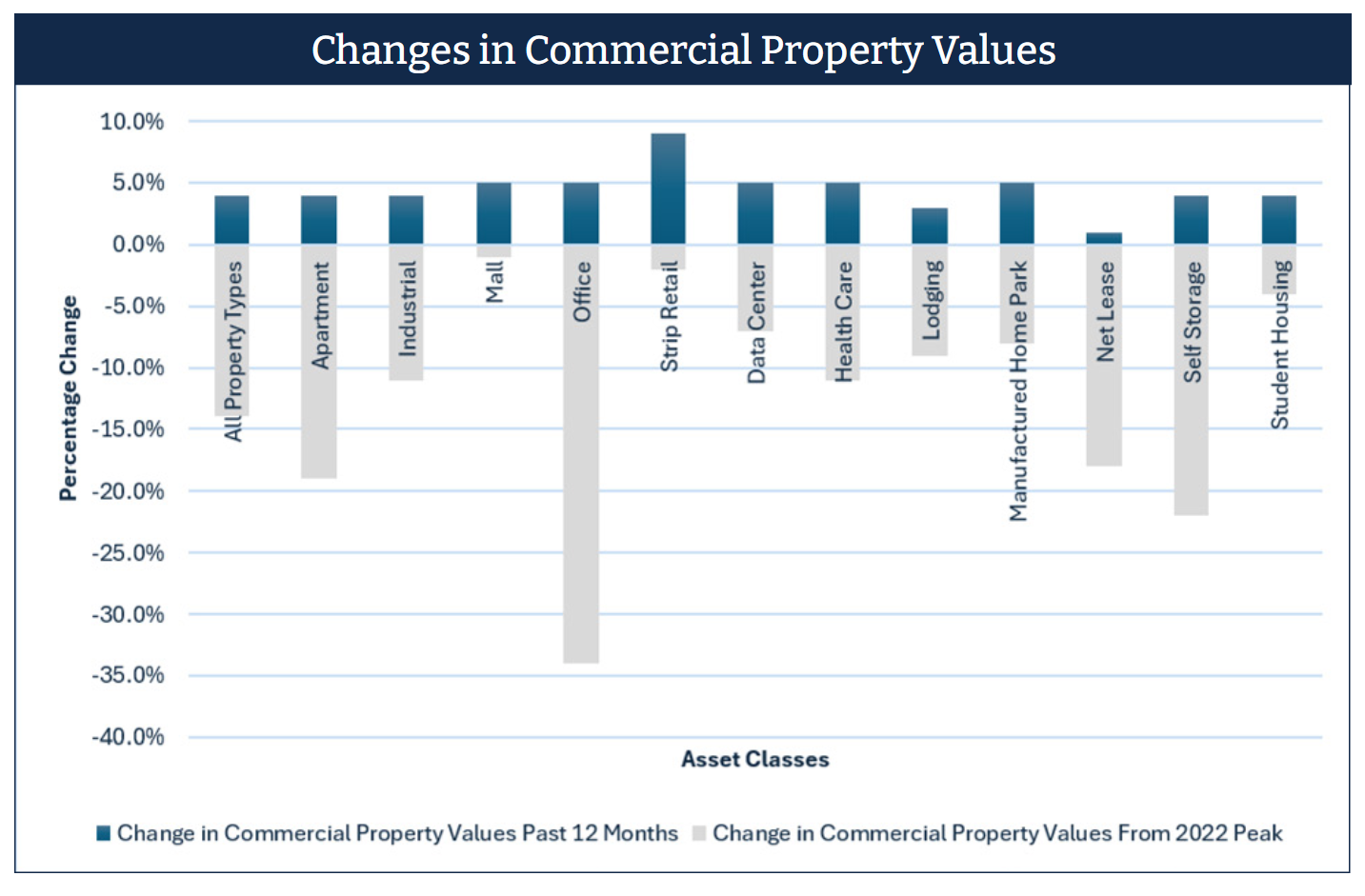
Another favorable market dynamic for private lenders has been the decline in commercial real estate valuations since the 2022 market peak. According to Green Street3, commercial property values remain materially below 2022 peak levels. Lower valuations and increased borrower equity contributions have enabled lenders to originate loans at lower loan-to-value ratios and with stronger structural protections. For private lenders, this provides the investment landscape to lend against assets at reset valuations while maintaining compelling yields and enhanced downside protection.
For pension investors, these dynamics may warrant increased consideration of real estate private debt. Higher base rates and wider lending spreads have increased income potential, while lenders are securing stronger covenants, lower leverage levels, and more favorable structures than were common during the low-rate period from 2010 through 2022. As a result, current market conditions may improve the relative attractiveness of certain real estate credit strategies compared with some real estate equity investments.
However, the appeal of private debt extends beyond yield. Pension funds must evaluate how these investments align with broader portfolio objectives and liability management requirements. This is where research initiatives become particularly valuable.
One key area of focus is liability-driven investing. Pension systems require predictable cash flows to meet future obligations, and real estate private debt can provide relatively stable income streams compared to more volatile equity investments. Research examining duration, cash flow consistency, and downside resilience can help investment committees determine whether private debt supports long-term funding objectives.
Performance attribution research is equally important. Pension decision makers increasingly seek to understand whether returns are driven by underwriting skill, structural protections, market inefficiencies, or higher risk exposure. Analysis across property sectors, geographies, and economic cycles can provide greater transparency into the drivers of performance.
Manager selection also remains critical. The private debt market is highly fragmented, and outcomes often depend on sourcing capabilities, underwriting discipline, borrower relationships, and workout expertise. Research evaluating historical loss rates, recoveries, covenant enforcement, and portfolio construction can help pension funds identify managers with repeatable investment processes.
Sector-specific analysis is another important consideration. Commercial real estate fundamentals vary widely across property types. Industrial, multifamily, and data center assets continue to benefit from long-term demand trends, while portions of the office sector face ongoing structural challenges. Research evaluating collateral quality and sector-specific risks can help investors allocate capital more effectively.
Looking ahead, elevated refinancing demand, constrained bank lending, and attractive income generation are likely to sustain institutional interest in real estate private debt. With nearly $2.8 trillion of commercial real estate debt maturing through 2028, private capital providers are widely expected to play an increasingly important role in commercial real estate financing markets.
For pension leaders, the opportunity lies not simply in increasing exposure to private debt, but in developing a disciplined research framework that connects market opportunities with long-term portfolio objectives. By focusing on liability matching, manager selection, sector analysis, and risk management, pension funds can improve decision quality while positioning themselves to capitalize on one of the most significant capital market shifts occurring within commercial real estate today.
Daniel Savage serves as Senior Vice President, Investments & Strategy, at Peachtree Group, a private equity investment management firm based in Atlanta, Georgia. He is responsible for the firm’s institutional business, including investment product structuring, capital formation strategy, and the management of relationships with investment consultants and other institutional stakeholders.
Daniel earned a Bachelor of Science in Finance, with a specialization in Financial Risk Management, from Virginia Tech and completed additional coursework at the London School of Economics and Political Science.
Endnotes:
1. Mortgage Bankers Association
2. Trepp Research, October 2025 (sourced from the Federal Reserve’s Financial Accounts of the United States)
3. Green Street Commercial Property Price Index (June 2026)