
Why Japan's Structural Story Has Years to Run
By: Daisuke Nomoto and Simon Morton-Grant, Columbia Threadneedle Investments
Learn about Japan’s structural transformation and explore thematic opportunities for investors. The article also highlights the potential of active management in a market riddled with inefficiencies.

Across boardrooms in Tokyo, the conversation has shifted from cash retention and stability to an urgent focus on shareholder returns and capital efficiency.
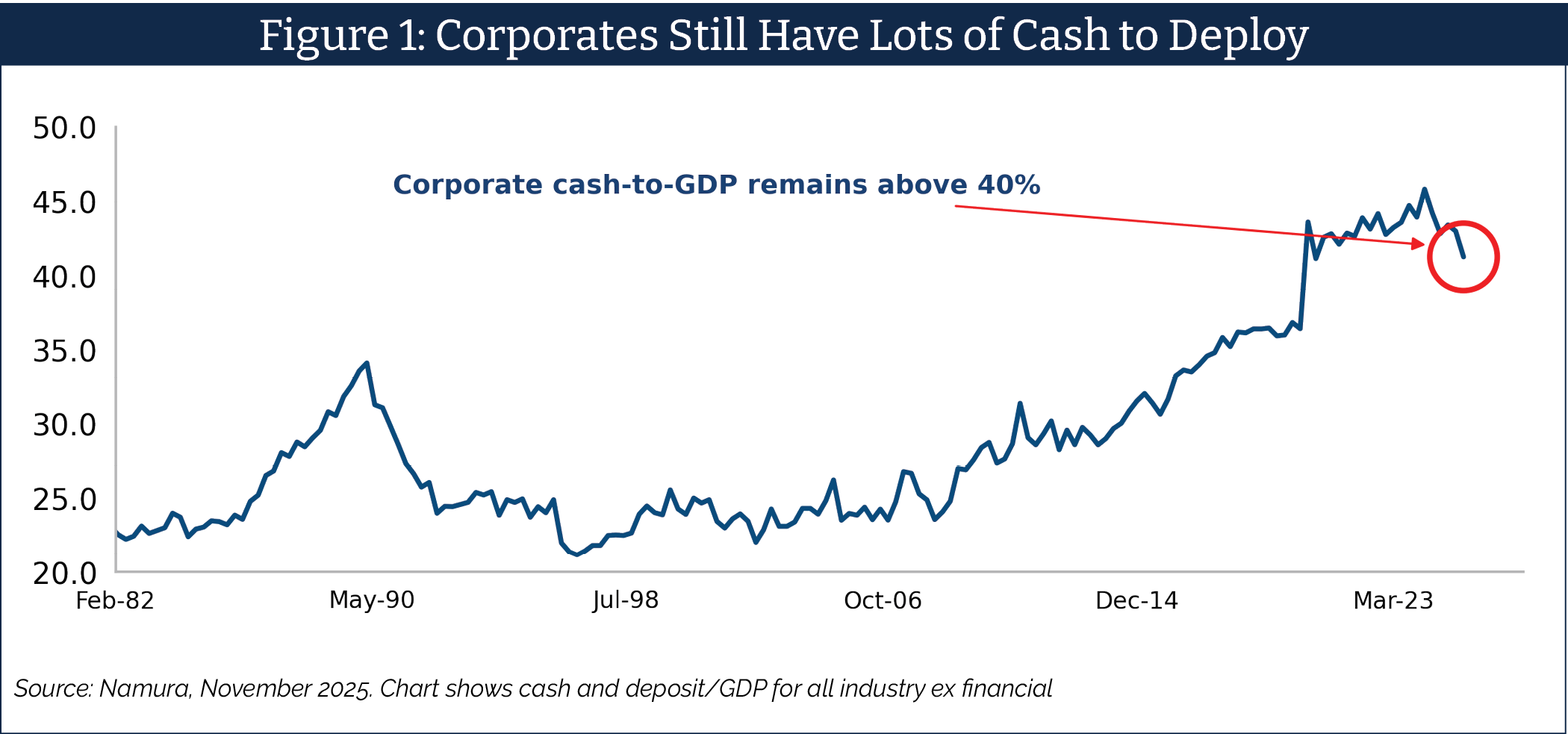
The numbers tell the story of gathering momentum. Japanese companies returned 60% of net income to shareholders in 2025, yet they are still sitting on cash equivalent to 40% of GDP — more than double the U.S. ratio (Figure 1). Share buybacks have multiplied nine times since 2012, cross-shareholdings continue to unwind, and dividends have doubled in 10 years.
Multiple Catalysts Align for Sustained Growth
Three powerful catalysts are converging to create a ‘why now’ moment.
- Shift from savings to investment culture. People are beginning to invest against a backdrop of persistent inflation and improved NISA accounts (Japan’s tax-free investment scheme).
- Nominal GDP growth is projecting upward, and the TOPIX historically tracks this trajectory.
- Japan’s political winds have shifted decisively. Takaichi pursues ‘Sanaenomics’ – a strategy that fuses economic growth with national security. With fiscal and monetary support, the government is partnering with private industry to dominate tomorrow’s critical technologies: artificial intelligence (AI), semiconductors, quantum computing, shipbuilding, cybersecurity, and digital content.
Relative to U.S. markets, Japanese equities trade at a significant discount – this positions Japan as a natural beneficiary of any rotation away from U.S. exceptionalism.
Japan’s Investment Landscape Transforms
Japan’s investment story is evolving beyond its traditional automation and digital transformation themes.
- AI adoption – addresses productivity challenges without the job displacement fears plaguing other nations.
- Infrastructure spending – infrastructure built 40-50 years ago during the high-growth and bubble eras requires comprehensive renovation. Construction companies stand to benefit.
- Fan culture – ‘Oshikatsu’ – supporting favorite idols, anime characters, VTubers, and athletes – now rivals the global anime industry in market size.
- Refloating shipbuilding – defense and maritime equipment sectors benefit from rising geopolitical tensions.
- Osaka’s reemergence – momentum builds behind Osaka’s ‘sub-capital’ vision signaling economic rival ahead.
The Wealth Creation Playbook: Japan Today Mirrors 1980s U.S. The parallels to America’s transformation in the early 1980s are striking and instructive. Back then, 40% of U.S. stocks traded below book value — almost identical to Japan today (Figure 2). American companies were directionless after the stagflation of the 1970s, just as Japanese firms remained shell-shocked decades after their bubble burst.
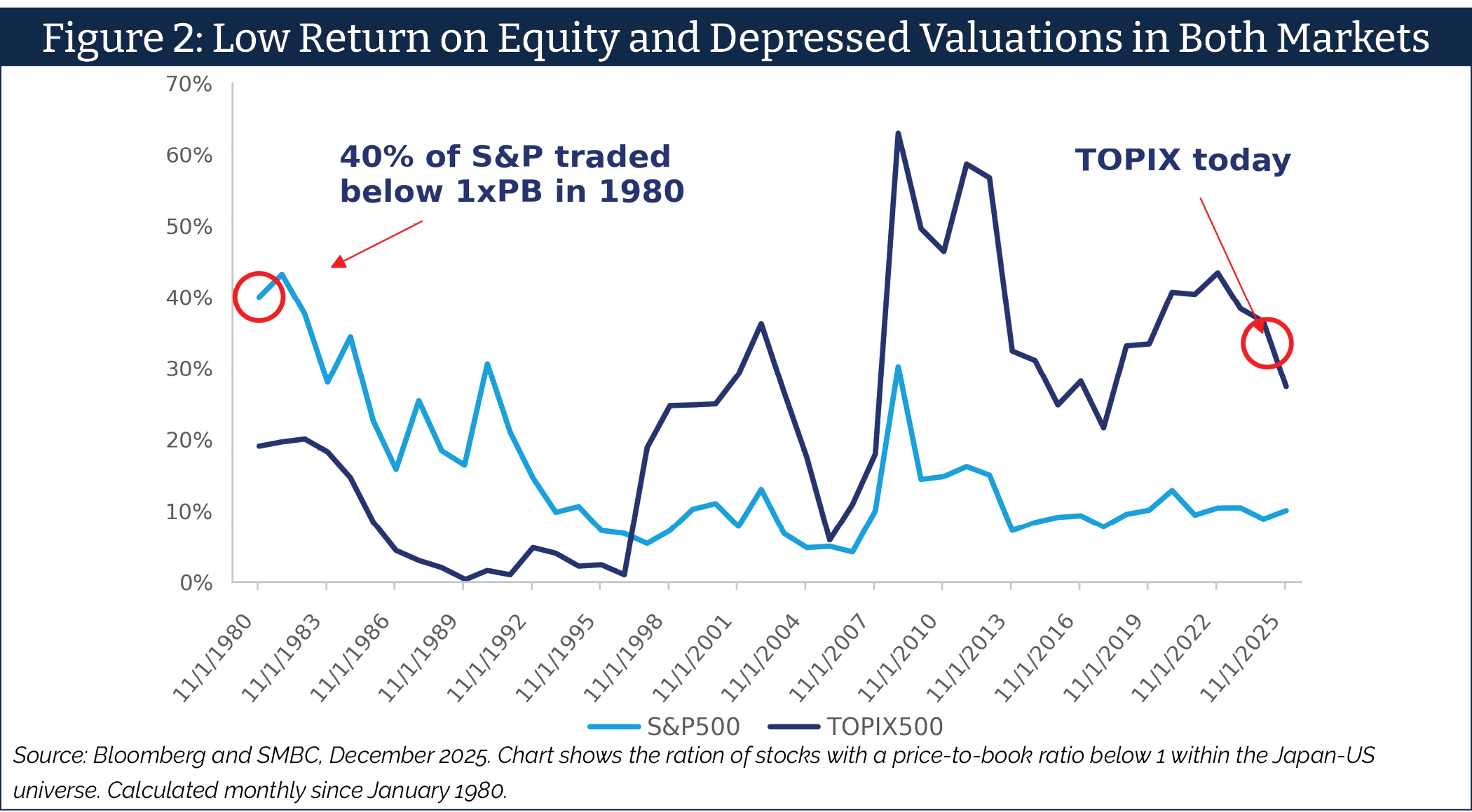
The catalyst in both cases was the same: a corporate awakening focused on shareholder returns.
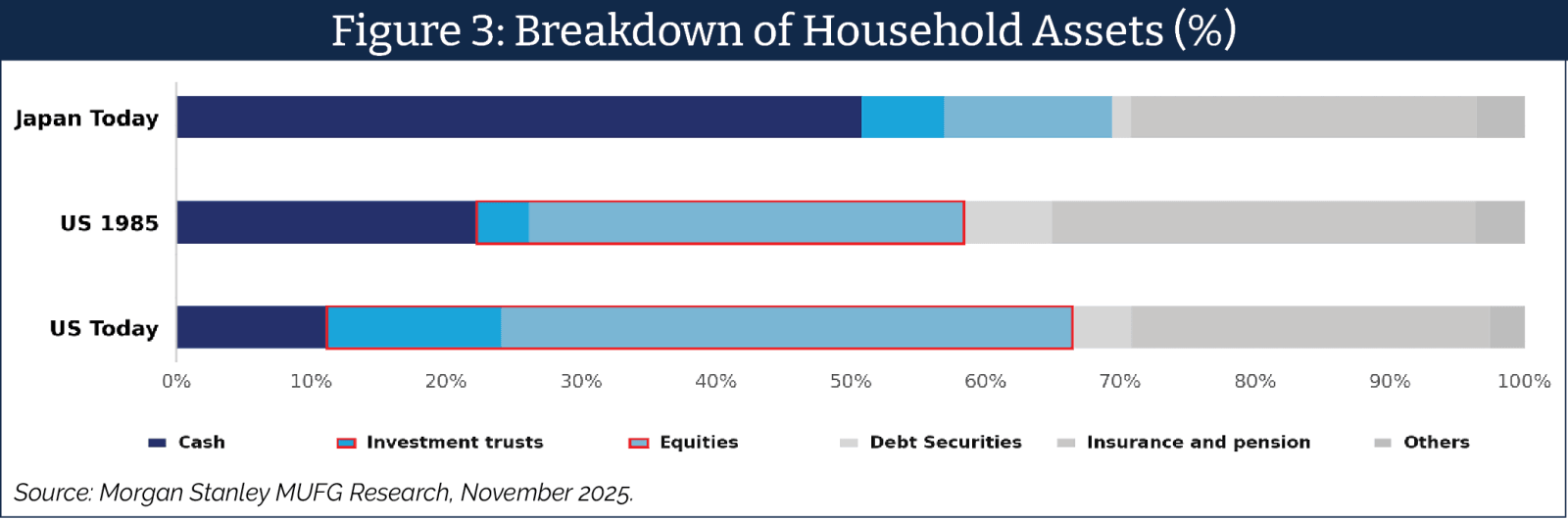
The retail investor revolution also provides another compelling parallel. Equity and investment trusts comprised just 36% of U.S. household allocation in 1985, growing to 55% today. Japan currently sits at 19% — way below 1985 U.S. level — and the trajectory is clear (Figure 3). With 50% of assets still in cash, the potential for reallocation into equities dwarfs what America experienced four decades ago. Japan’s NISA accounts are following a similar transformative path that 401(k)s and IRAs carved in the U.S.
The Active Advantage: Navigating Inefficiency
Japan’s transformation demands an active investment approach. The evidence is clear: The median active Japan equity manager outperforms the MSCI Japan Index over every time period in the past decade. Active managers are well positioned to create genuine alpha opportunities from a market riddled with inefficiencies.
Our quality core investment approach strategically targets exceptional, inexpensive businesses with strong fundamentals and management teams dedicated to unlocking shareholder value.
The Bottom Line: Japan’s Defining Investment Moment
Japan’s renaissance isn’t a cyclical upturn; it is a structural transformation that could span decades. The convergence of corporate governance reform, demographic-driven capital reallocation and political realignment creates a compelling multi-year investment thesis.
The structural drivers remain intact, the runway for reform extends years ahead, and the opportunity for active managers to generate alpha has rarely been more compelling. We believe Japan’s renaissance is just beginning — and those who recognize its structural nature today will be best positioned to benefit from the transformation ahead.
About the authors: Daisuke Nomoto, CMA (SAAJ) - head of Japanese equities at Columbia Threadneedle Investments. Prior to his current role, he was a director and senior portfolio manager on the Overseas Equity team.
Simon Morton-Grant - client portfolio manager within the Japan and Asia Equity teams. Responsible for providing detailed information on the company’s capabilities and investment views to existing and prospective clients as well as to consultants and other intermediaries.