
A Roadmap to Full Funding for Public Pension Plans
By: Daniel J. Siblik and Julian Regan, Segal

As many public sector pension plans approach full funding, decisions made before then will shape long-term stability. As funding improves, risk profiles change. A surplus-management strategy can guide decision-making and risk management.
Collaboration with the plan’s actuary and investment consultant facilitates a comprehensive approach to reducing risks.
What Full Funding Means
A funded ratio above 100% results in a surplus but does not suggest there are excess assets available for discretionary use. Normal Cost (the value of benefits accruing in the coming year) continues if members accrue benefits, so the plan must still be funded.
Misunderstanding surplus as extra assets creates risk, and sponsors may face pressure for contribution holidays, benefit enhancements, and aggressive assumption changes.
Three state systems and the District of Columbia are at collective full funding. Eleven states have systems collectively at 90% funding or higher.
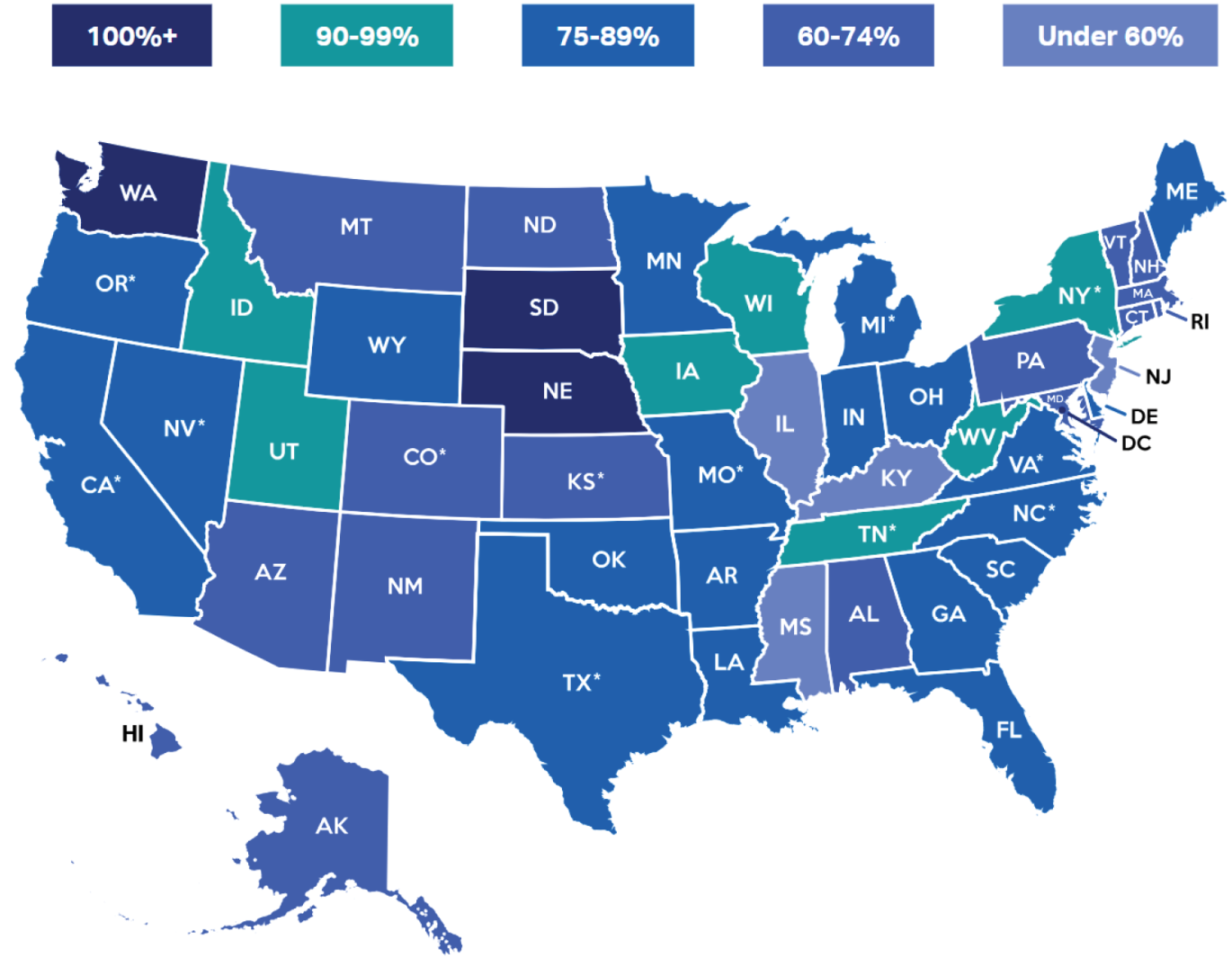 Source: Segal using data from NASRA with permission. Includes 2024 information, based on availability. To request a table showing the funded ratio for each state, fill out the short form on the Segal website.
Full Funding Within Reach Again
Decades ago, many plans were fully funded and subsequent benefits improvements were implemented, prior to the market downturn in 2000–2002 and the 2007–2009 global financial crisis.
Decreasing prevailing interest rates increased plan liabilities, lowering funding levels. Generational mortality reflected longer lives, also increasing liabilities. Subsequently, public sector pension plans’ contributions rose. Improvements in funded status are largely attributable to tightened benefit levels, contribution discipline, and strong investment returns.
Funded ratios of state public pension systems vary. The aggregate funded ratio for state pension plans was 78.8% for fiscal 2025, according to the National Association of State Retirement Administrators (NASRA).
Deliberate strategies on funding surplus use can prevent a return to underfunding.
Surplus-Management Strategies Drive Long-Term Stability
Establishing surplus-management strategies before full funding reduces future funded status and contribution volatility, manages stakeholder expectations, and preserves financial stability. Strategies should align with funding policy best practices established by the Government Finance Officers Association. Stakeholders can understand there is a specified, measured process to be followed with surplus funding.
Funding policies should consider using surpluses to manage risks and consider benefit modification, within risk tolerances. Key components are actuarial assumptions, contribution volatility management, benefit adequacy, and investment strategy.
Ask Your Actuary to Examine Assumptions and Methods
Overly optimistic actuarial assumptions inflate surpluses and undermine long-term funding. Options for revisiting assumptions and methods include:
- Amortize unfunded liabilities shorter and credit surpluses longer.
- Consider a buffer (e.g. 120% funded status) before utilizing surplus.
- Add margin to assumptions for adverse deviation.
- Revisit expected investment return.
- Use a glide path to reduce volatility of future rate declines, preventing abrupt increases from market losses.
Manage Contribution Volatility
At full funding, the Unfunded Actuarial Accrued Liability (UAAL) portion of the contribution expires, dropping the rate which causes an increase in the rate upon adverse experience (investment or other).
Consider a glide path that smooths the contribution rate reduction. For example, a newly calculated UAAL contribution rate less than a set percentage of payroll, while maintaining the prior year’s contribution rate, or limiting to a percentage of payroll.
Budgeting for pension plan contributions accommodates decreases easily, but subsequent increases are harder to implement, especially after reductions.
Evaluate Contemplated Benefit Enhancements
Some stakeholders advocate benefit enhancements upon full funding. Experience suggests resisting that pressure. Benefit increases (often on past service) left some plans poorly funded with higher benefit costs as investment markets corrected.
Surplus-management strategies can specify conditions to meet before considering benefit enhancements, and stress testing scenarios to demonstrate the exposure benefit enhancement scenarios create.
Adjust Investment Strategy to Mitigate Negative Cash Flow
Mature public pension plans typically have negative cash flows (payouts exceed contributions). At full funding, contributions fall when UAAL amortization components end and negative cash flows increase as benefit payments rise, e.g. from 2% to 5–10% of the portfolio.
As investment income increases as a percentage of the inflows, plans must maintain liquidity without selling assets at inopportune times, causing suboptimal investment performance. Not planning for liquidity needs amplifies market losses, increasing funded status volatility.
Sponsors should consider resetting their risk tolerance and reducing volatility by rethinking their asset allocation.
Consider These Decision-Making Tools for Surplus-Management Strategies
Stress testing: Evaluates various scenarios. Helps explore how economic volatility affects contribution levels and liquidity.
Asset-liability modeling (ALM):Risk-management technique considering plan demographics, contributions, and cash flow. A best practice for integrating decisions on plan assets and liabilities.
Stochastic modeling: Uses simulations and probabilities to project ranges of possible investment outcomes (and associated funding/contribution levels) with associated likelihoods.
Liquidity tier analysis:Categorizes investments according to how quickly they can be converted to cash to pay benefits.
Learn more: Obtain the National Conference on Public Employee Retirement Systems (NCPERS) guide to Best Governance Practices for Public Retirement Systems, which NCPERS developed in collaboration with Segal Marco Advisors. The guide includes a model framework for risk management.
Governance Coordination Is Increasingly Important as Full Funding Approaches
Coordination between the plan’s actuary and investment consultant helps ensure a shared understanding of the assumptions, cash-flow needs, and risk tolerance. For example, reducing portfolio risk likely lowers the assumed investment return and discount rate, which then lowers the funded ratio.
This article is a summary of a more extensive analysis. Click here to read the full report on the Segal website.
Daniel J. Siblik is a Vice President and Actuary with Segal with more than 30 years of experience as a benefits consultant, focusing on Public Sector pension plans in different parts of the country.
Julian Regan is a Senior Vice President and Public Sector Market Leader for Segal Marco Advisors, previously serving as Executive Director, New York State Deferred Compensation Board and Assistant General Manager/Budget Director, Massachusetts Bay Transportation Authority (MBTA).