
The Athlete-Driven Opportunity Set: Unlocking the Ecosystem’s High-Growth and Scalable End Markets
By: Joe Brown, Whitney Mishler, and Ben Kahne, EnTrust Global
This piece discusses investment opportunities within the sports, media, and entertainment industry, providing an
overview of the growing global sports market and the compelling “picks-and-shovels” opportunities available to investors.

In recent years, institutional capital’s pursuit of sports assets has accelerated at an unprecedented pace. While the largest allocators on Wall Street compete for stakes in established leagues, we see a more attractive opportunity set across large, fragmented, white-space markets within sports, media, and entertainment (“SME”): the data, media, technology, and consumer businesses that support the broader ecosystem. In these markets, athlete adjacency and IP can serve as a bridge for credibility, access, or distribution, driving organic growth for companies operating in these commercial sub-sectors. The opportunity is driven by power and attention shifting to the players, increasing the commercial value of athlete IP. This dynamic makes the “picks-and-shovels” layer – the businesses that authenticate, distribute, monetize, and scale athlete IP – a more durable opportunity than the marquee assets themselves.
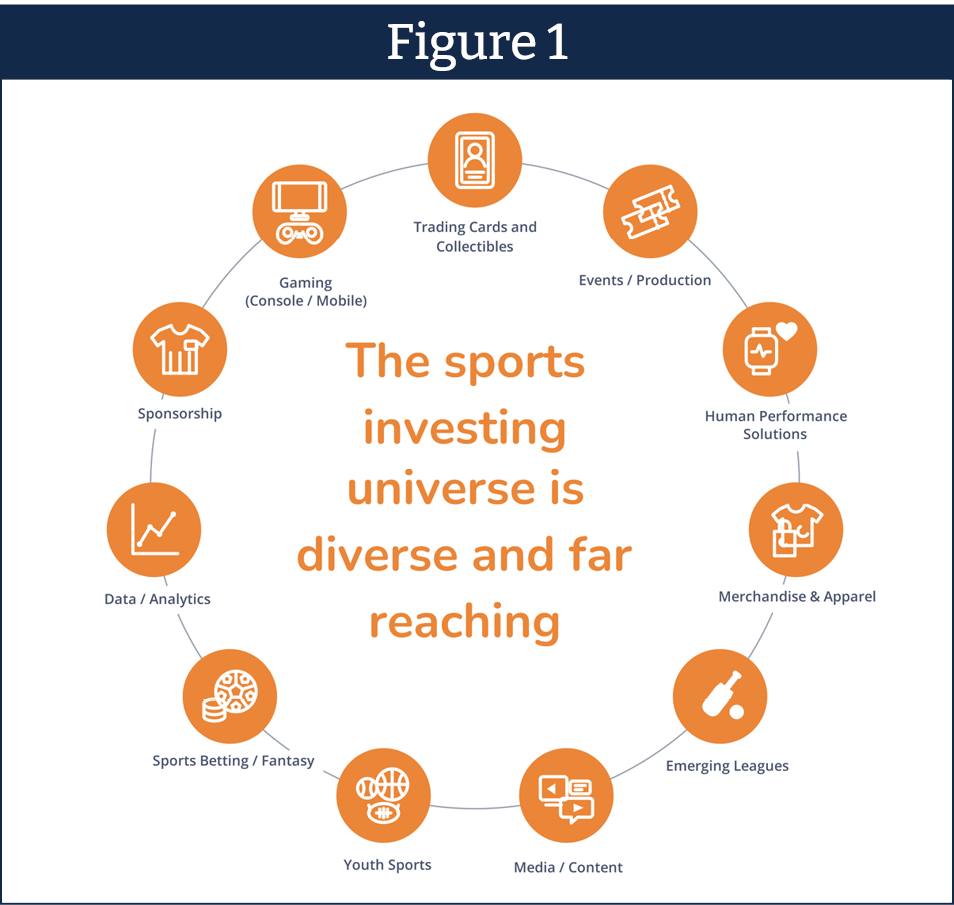 The highly fragmented markets within SME verticals, live entertainment & events, collectibles & memorabilia, youth sports, sports betting and fantasy, NIL and licensing, human performance solutions, and more, present significant growth opportunities, as the underlying infrastructure in many markets is still being developed. We believe rising valuations across major professional leagues are spilling over into these adjacent categories, creating disruption as they institutionalize; sports betting is a clear case, having moved past its initial legalization-driven growth into a second wave built on the data, payments, and personalization infrastructure underneath the consumer product. Across the SME universe, the tools and platforms enabling athlete performance, broadcast, and fan engagement are compounding fast.
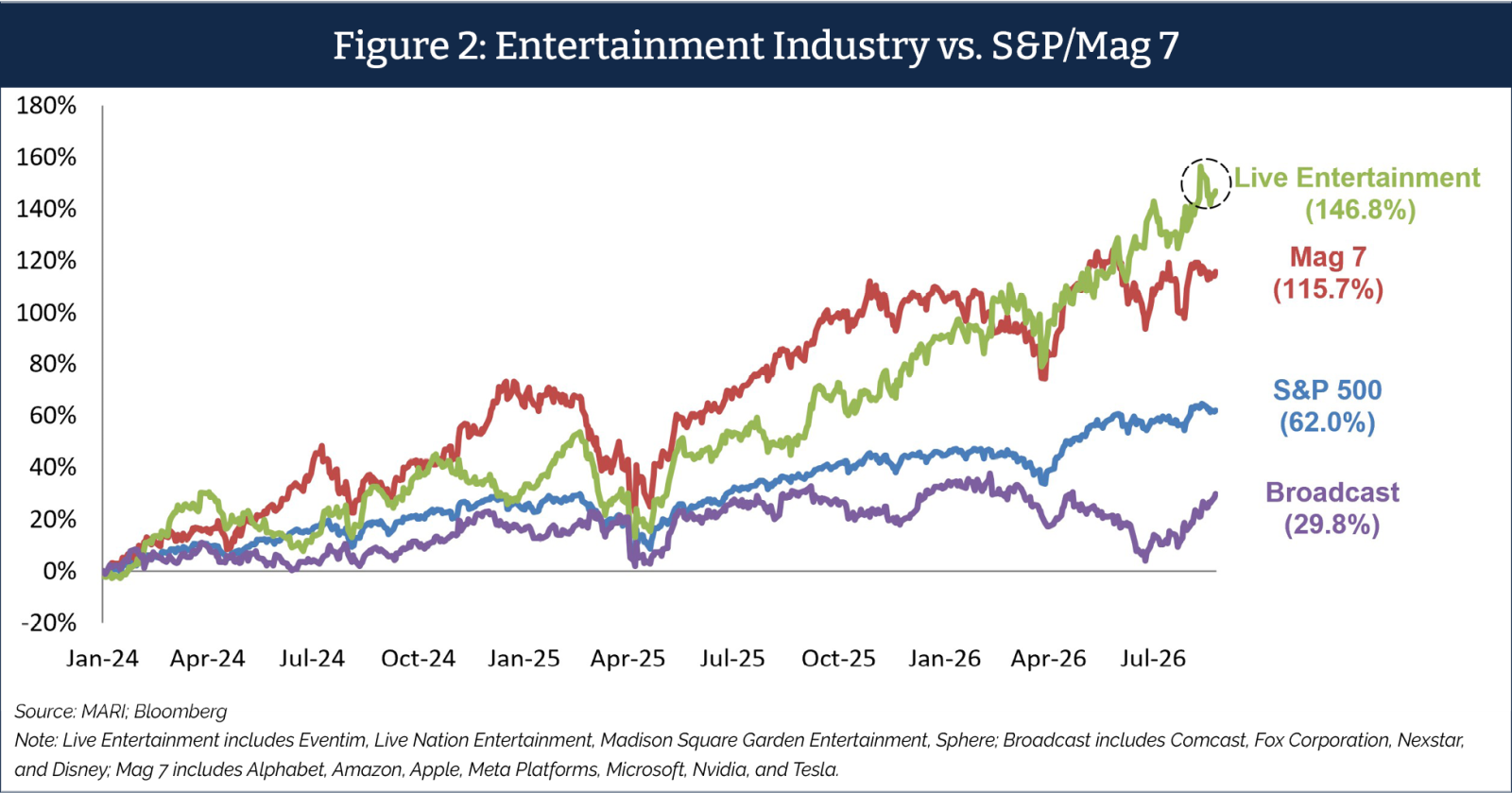
Of these categories, live entertainment & events is one sector set to capitalize on the growing demand for in-person experiences. The global experience economy is now estimated to be worth more than $1 trillion, and the global live entertainment market alone is projected to grow from $535 billion in 2025 to $859 billion by 2034.1 Live entertainment’s growth is being fueled by two converging forces: screen fatigue from social media and AI is making in-person experiences more valuable, while a decades-long decline in average hours worked is freeing up time and discretionary income.2
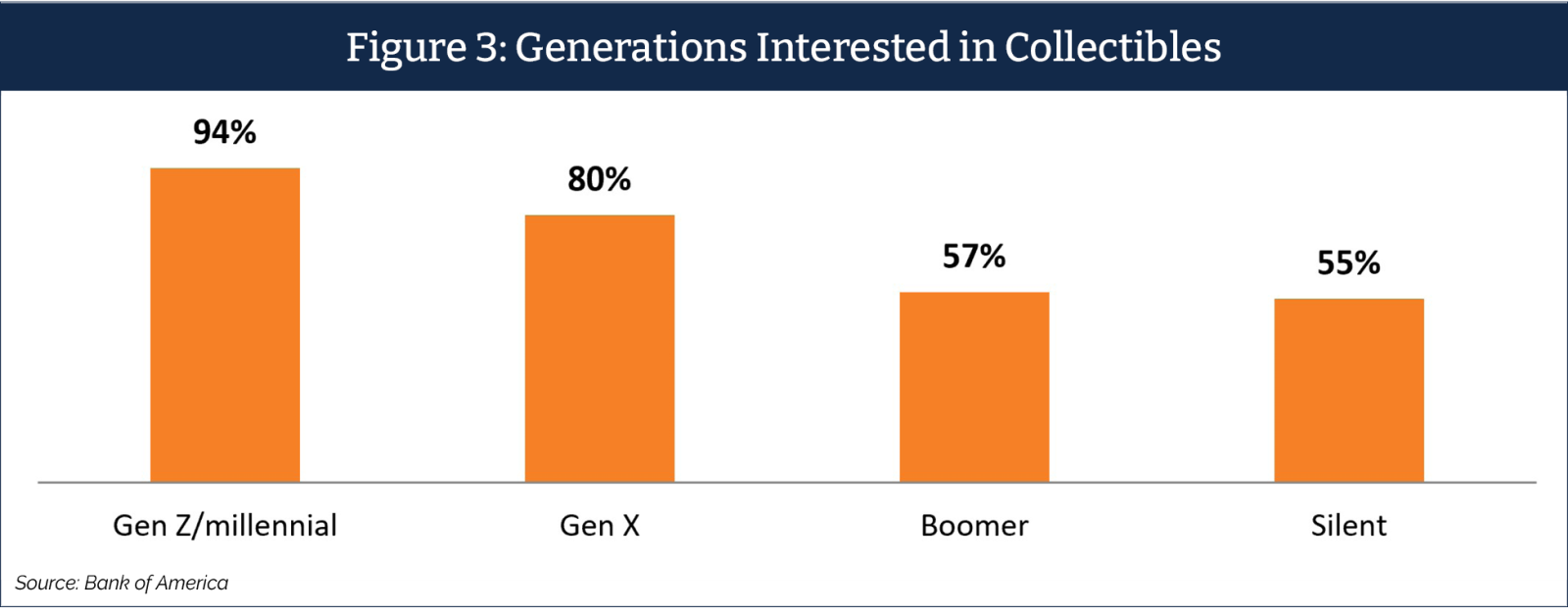
Collectibles and memorabilia are another clear example of this dynamic, with unprecedented growth playing out across authentication, monetization, and commerce infrastructure alike. The global collectibles market is projected to grow from $335.7 billion in 2026 to $535.5 billion by 2033, at a CAGR of 6.9%.3 Collectibles is one of the fastest-growing segments in the broader gaming industry, characterized by strong secular tailwinds and accelerating demand, especially from younger consumers. In addition, the sector’s growth is outpacing the industry’s own infrastructure: as of August 2026, the world’s largest third-party trading card authentication company carried an active grading backlog of nearly 12 million units, with non-sports and trading-card-game submissions up 81% year-over-year, a clear sign that authentication and grading capacity still lags demand.4
Value is captured at several distinct points across the collectibles and memorabilia space: grading and authentication services, which establish condition, provenance, and trust; live commerce and “breaking” platforms, where sealed products are opened in real-time; secondary marketplaces that facilitate liquidity and price discovery; and a growing data and technology layer supporting valuation, collection management, and marketplace infrastructure.
The market for human performance solutions is another market that sits at the intersection of wellness, technology, and athletes. The global sports technology market, which includes human performance solutions, was valued at ~$23 billion in 2025 and is projected to reach $120 billion by 2033 at a 23% CAGR, driven by increasing adoption of data-driven performance analytics, AI-enabled training systems, and broader health and wellness trends.5
Top-performing athletes spend millions of dollars annually on body maintenance to sustain peak performance, with LeBron James reportedly investing over $1.5 million a year alone in his personal wellness.6
Team and league valuations have priced in much of the obvious upside; the more durable opportunity lies in the picks-and-shovels layer, the businesses that surround those teams and leagues. The depth and breadth of the SME market go far beyond the obvious headlines. Beneath team and league ownership sits a much wider and deeper layer of commercial activity. Many of these sectors operate on their own supply chain, incumbents, and pace of consolidation, yet all of them draw on the same underlying force: rising engagement with the athletes, teams, creators, and leagues at the center of the ecosystem. No longer are these sectors a loose collection of independent, single-purpose businesses; they are consolidating into scaled, professionally managed platforms built to capture demand at scale.
Joe Brown is a Senior Managing Director at EnTrust Global, in which capacity he helps lead its early- to growth-stage SME strategy, EnOne Ventures. Most recently, he served as Head of Strategic Investments at OneTeam Partners. Joe holds an MBA from Columbia Business School and a BS in Economics with a concentration in Finance from The Wharton School of the University of Pennsylvania.
Whitney Mishler is a Senior Managing Director at EnTrust, in which capacity he helps lead EnOne Ventures. His investment experience ranges across diverse sectors, including SME, and spans the lifecycle of companies. Whitney holds a BS double major in Finance and Entrepreneurship from Syracuse University’s Martin J. Whitman School of Management and holds the CFA designation.
Ben Kahne is an Associate at EnTrust Global on the Investment Team. Ben holds a BA in Political Science, with a concentration in Political Economy, and a Certificate in Markets and Management Studies, from Duke University.
1 Source: https://www.forbes.com/sites/katehardcastle/2026/04/01/the-trillion-dollar-experience-economy-and-the-growing-execution-gap/; https://finance.yahoo.com/markets/stocks/articles/global-live-entertainment-market-size-143000430.html
2 Source: Bureau of Labor Statistics
3 Source: https://www.grandviewresearch.com/industry-analysis/collectibles-market-report
4 Source: https://www.psacard.com/info/backlog-tracker
5 Source: https://www.grandviewresearch.com/industry-analysis/sports-technology-market
Disclosures: PAST PERFORMANCE DOES NOT GUARANTEE FUTURE RESULTS. Statements or opinions reflecting predictions or perceived trends in the sports, media and entertainment industry may be incorrect. Charts, tables and graphs contained in this document are not intended to be used to assist the reader in determining which securities to buy or sell or when to buy or sell securities. Targeted projections are HYPOTHETICAL and are not actual returns, profit forecasts or predictions. They are presented for illustrative purposes only and may only be achieved under certain conditions. There is no guarantee that these conditions will occur. This presentation does not represent all possible scenarios or outcomes and actual performance results may vary materially.