
Understanding the Private Infrastructure Opportunity
By: Christopher Tessman, Wilshire

Infrastructure has moved from a niche real assets allocation toward a more central role in diversified portfolios. Artificial intelligence, digitalization, the energy transition, population growth, and logistics demand are increasing the need for transportation, power, renewables, water, waste, fiber, cell towers, data centers, schools, and hospitals.
Many infrastructure assets have long useful lives, high barriers to entry, and contractual or regulated revenue streams. Some also include inflation linkage through rate structures or Consumer Price Index escalators. These characteristics may support durable cash flows, diversification, and downside resilience relative to more economically sensitive assets.
One estimate suggests approximately $106 trillion of infrastructure investment will be needed through 2040.1 With public funding unlikely to meet the full requirement, private capital may play a larger role across energy, digital infrastructure, transportation, and essential services.
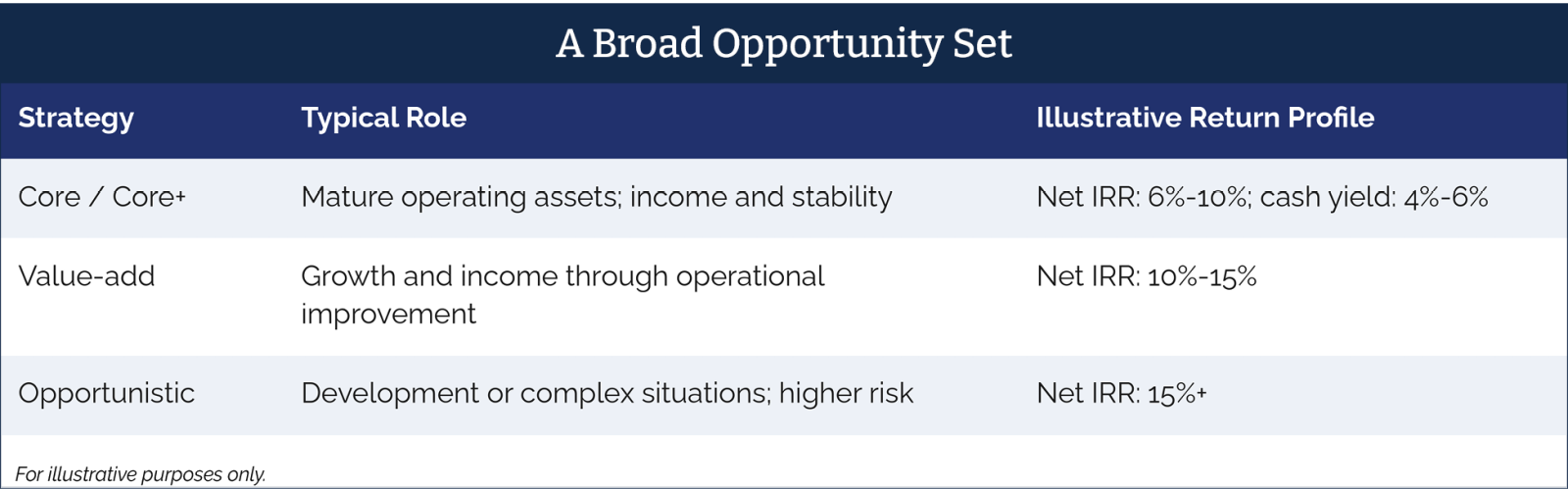
Two themes stand out. AI is increasing demand for data centers, fiber, communications towers, and electricity. The energy transition is driving investment in renewable generation, grid upgrades, storage, and resiliency. These forces are expanding the opportunity set beyond traditional core assets and into value-add strategies where development and operational expertise may create value.
Potential Portfolio Role
Our analysis found that private infrastructure had low correlation to public equities and near-zero correlation to fixed income over the period measured. In above-average inflation quarters, U.S. private infrastructure generated positive average quarterly returns while fixed income was negative. During the 10 worst equity quarters reviewed, private infrastructure also produced a positive average return while equities declined. Historical results do not guarantee future outcomes, but the pattern illustrates infrastructure’s potential diversification and stabilizing role.2
Manager selection remains important. Large infrastructure deals may offer scale and long-term contracts, while smaller and middle-market opportunities can be less efficiently priced and more dependent on operational improvement. Historically, smaller funds have shown stronger return potential, although this trend may not persist.
Liquidity Should Shape Allocation Size
Private infrastructure has historically been accessed through closed-end funds with long lockups and high minimums. Interval funds offer broader access but are not equivalent to public securities. Quarterly repurchase offers are commonly limited, and redemptions may be reduced or gated during periods of high demand. Allocation size should reflect the investor’s time horizon, cash needs, and tolerance for illiquidity.
A practical approach is to compare each holding’s liquidity access with its portfolio weight. A modest allocation to a less-liquid vehicle may leave overall portfolio liquidity relatively high. The goal is to ensure expected access remains above the investor’s liquidity preference.
Infrastructure may provide long-duration demand, income potential, inflation sensitivity, and diversification. As digitalization and the energy transition reshape capital needs, investors may consider how infrastructure fits within private markets portfolios, subject to objectives, risk tolerance, and liquidity requirements.
Click here to read the full paper, Infrastructure Explained, at the Wilshire website.
Christopher Tessman is a Senior Vice President at Wilshire, specializing in client service for public pension plans and overseeing Wilshire Compass. Since joining Wilshire in 2000, Mr. Tessman has played a key role in advising a diverse array of asset owners, including public and corporate pension plans, foundations, endowments, insurance companies, family offices, and other wealth managers.
1 McKinsey & Company, The Infrastructure Moment, September 9, 2025.
2 Wilshire. The internal rate of return (IRR) is the annualized return measure standard in private markets. The return targets shown above represent general market expectations based on infrastructure manager consensus and recent market transactions and do not represent the performance of any specific fund, account, or investment managed by Wilshire. These targets are not guarantees, projections, or predictions of future performance. Actual returns may be higher or lower than the targets shown, and investors may lose some or all of their invested capital. Past performance is not indicative of future results. For illustrative and discussion purposes only.
Disclosures: Wilshire Advisors LLC (“Wilshire”) is an SEC-registered investment adviser serving diverse institutional and intermediary clients. Wilshire’s products, services, and advice may differ among clients and may not be available to all investors. Information presented is for informational purposes only, does not constitute legal, tax, accounting, or investment advice, and is subject to change. Certain data has been obtained from third-party sources believed reliable, but accuracy is not guaranteed. Charts, forecasts, and projections are for illustrative purposes only and do not reflect actual or expected performance. Past performance is not indicative of future results. This material may include forward-looking statements which reflect Wilshire’s current views, involve risks and uncertainties, and may change without notice. Reliance on such statements should be limited. For additional information, please review Wilshire’s ADV Part 2 at www.wilshire.com/ADV.
Wilshire® is a registered service mark.
Copyright © 2026 Wilshire. All rights reserved.
M1002740 E0927