
A Step-by-Step Guide to Risk Budgeting
By: Lauren Gellhaus, Wilshire
A practical guide to risk budgeting that explains how to allocate and monitor portfolio risk to align with objectives, enhance governance, and optimize returns.

Risk budgeting is a disciplined framework for allocating and managing risk across a portfolio, aiming to maximize excess return while aligning with organizational objectives. This guide outlines the key steps and best practices for establishing and implementing a risk budget.
What is Risk Budgeting?
Risk budgeting involves setting risk limits across asset classes and balancing risk contributions rather than just capital allocations. It requires clear governance, robust measurement tools, and ongoing monitoring to ensure risks are intentional and aligned with objectives.
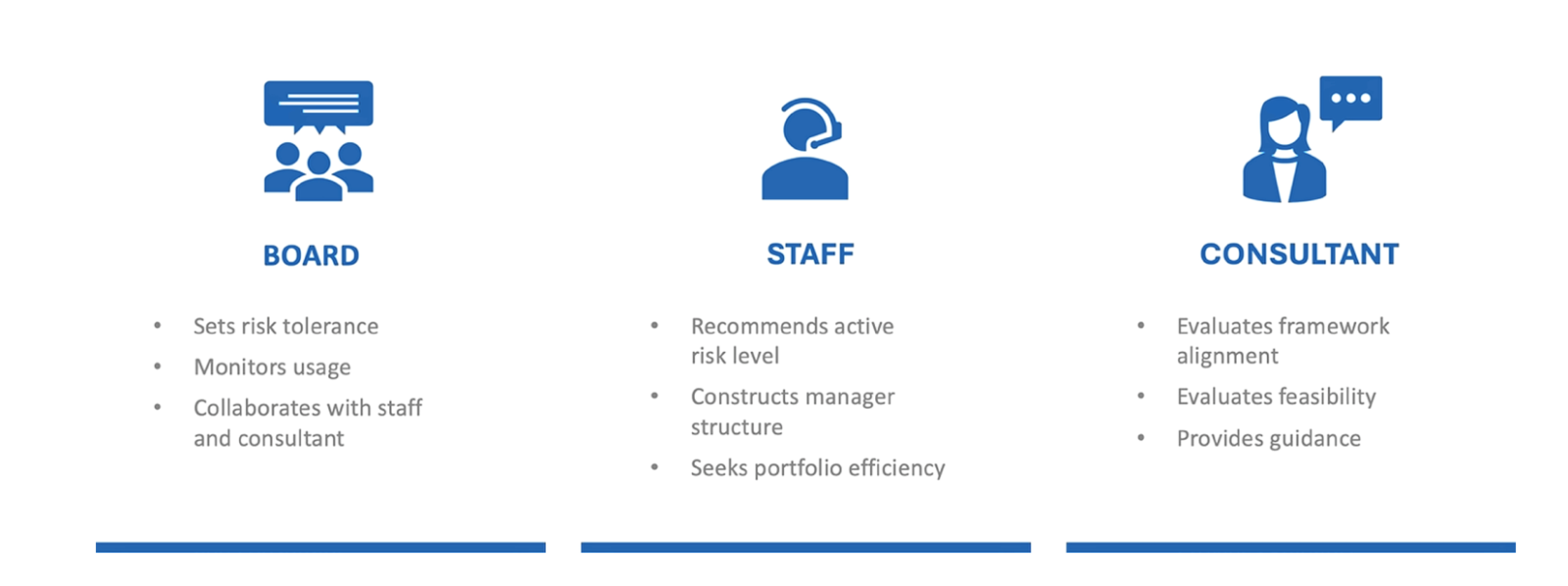
Key Roles in Risk Budgeting
Key stakeholders in risk budgeting — board, staff, and consultant — each have distinct responsibilities.
Implementation Steps
- Identify Investment Objectives and Risk Tolerance: Define clear objectives (e.g., return targets, funding ratios) and determine acceptable risk levels through discussion, surveys, or recommendations.
- Establish Risk Budgets Across Asset Classes: Allocate risk (not just capital) to ensure true diversification. Distinguish between allocation risk (deviations from targets) and selection risk (manager choices). Use actionable tracking error for private markets, focusing on controllable drivers.
- Outline Governance: Formalize accountability and review processes in policy documents to maintain discipline and reduce unintended exposures.
- Implement Measurement and Monitoring Systems: Use tools (e.g., Wilshire’s risk dashboards) to analyze risk contributions, track trends, and balance risk and return.
- Rebalance Dynamically: Adjust portfolios as market conditions change, eliminating unintentional tilts and monitoring intentional risks for alpha generation.
Best Practices and Considerations
- Avoid over-reliance on historical data; incorporate forward-looking models.
- Stress test risk estimates and revisit budgets periodically.
- Manage behavioral biases and complexity in dynamic risk budgets.
- Monitor contributors to active risk, such as benchmark mismatch and systematic factor exposures.
Conclusion
Effective risk budgeting is an ongoing process requiring adaptability, transparency, and collaboration. By understanding risk drivers and maintaining robust governance, investors can prudently allocate risk and pursue excess returns.
Click here to read the full paper on risk budgeting at the Wilshire website.
About the author: Lauren Gellhaus, CAIA, Vice President serves on Wilshire's client solutions teams and is the chair of the firm's ESG and Diversity Committee. She is a senior consultant, working primarily with public pension plans and she specializes in sustainability.
Disclosures: Wilshire is a global financial services firm providing diverse services to various types of investors and intermediaries. Wilshire’s products, services, investment approach and advice may differ between clients and all of Wilshire’s products and services may not be available to all clients. For more information regarding Wilshire’s services, please see Wilshire’s ADV Part 2 available at www.wilshire.com/ADV.
Wilshire believes that the information obtained from third party sources contained herein is reliable, but has not undertaken to verify such information. Wilshire gives no representations or warranties as to the accuracy of such information, and accepts no responsibility or liability (including for indirect, consequential or incidental damages) for any error, omission or inaccuracy in such information and for results obtained from its use.
This material is intended for informational purposes only and should not be construed as legal, accounting, tax, investment, or other professional advice. Final terms set forth in a written agreement will prevail. Any charts, graphics, projections, and forecasts included in this Presentation are presented for illustrative purposes only, in order to provide information and context. None of the statements or information contained in this Presentation constitute investment performance, nor should the inclusion of any information be treated as indicative of, or a proxy for, the investment performance of Wilshire.
This material may include estimates, projections, assumptions and other "forward-looking statements." Forward-looking statements represent Wilshire's current beliefs and opinions in respect of potential future events. These statements are not guarantees of future performance and undue reliance should not be placed on them. Such forward-looking statements necessarily involve known and unknown risks and uncertainties, which may cause actual events, performance and financial results to differ materially from any projections. Forward-looking statements speak only as of the date on which they are made and are subject to change without notice. Wilshire undertakes no obligation to update or revise any forward-looking statements.
Wilshire Advisors LLC (Wilshire) is an investment advisor registered with the SEC. Wilshire® is a registered service mark.
Copyright © 2026 Wilshire. All rights reserved.
M855094 E1226