
Direct Lending is Not Homogenous
By: Homyar Choksi, CIFC Asset Management
In direct lending, manager selection is a critical driver of risk, return, and portfolio resilience. This article highlights the importance of evaluating managers based on where they invest and their credit underwriting discipline, including their avoidance of PIK income, and how rigorously they structure covenant protections.

Direct lending has evolved from a niche allocation into a core holding for many public pension portfolios. That shift has expanded opportunity, but it has also raised the stakes on a critical and often underestimated decision: manager selection. As capital has poured into the asset class, the dispersion between the strongest and the weakest managers has widened, even as strategies and marketing materials increasingly look alike.
For investment committees, the question is no longer whether to allocate to direct lending, but which manager to entrust with that allocation. The manager is not just the vehicle for exposure but also the primary determinant of risk, return, and portfolio resilience.
In benign markets, most direct lending portfolios look alike: floating-rate income, senior secured exposure, muted volatility — precisely the conditions in which managers are hardest to tell apart. True dispersion emerges most poignantly during periods of stress, by which point manager selection decisions are already locked in. The most important diligence, therefore, must occur before committing capital: identifying the manager whose underwriting discipline is rewarded when economic conditions deteriorate.
Where a Manager Invests Matters
Direct lending is not a monolithic asset class. A manager’s target segment fundamentally shapes outcomes, influencing competition levels, underwriting standards, leverage tolerance, and documentation quality.
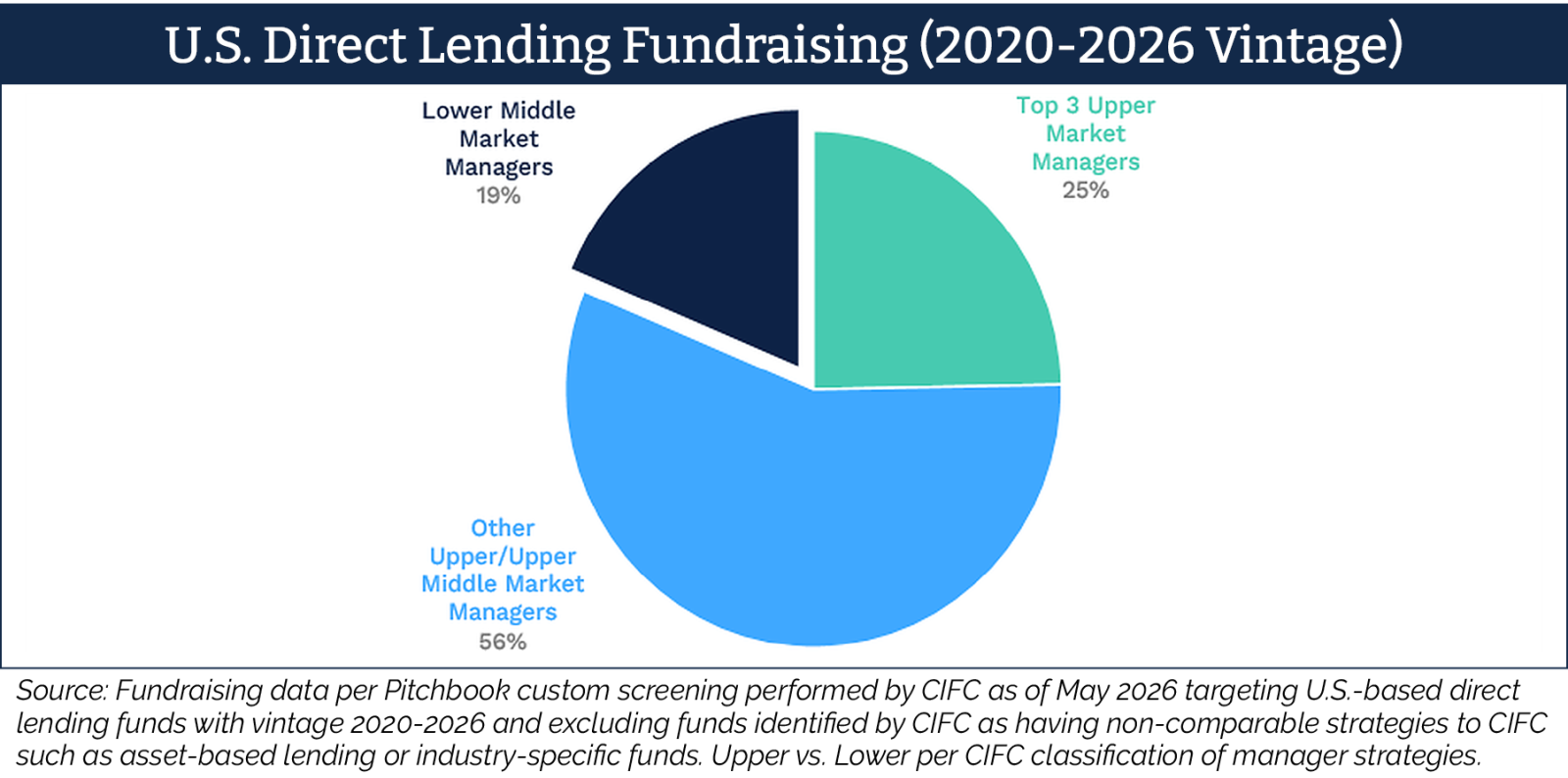
Significant capital has flowed into the upper-middle and upper market, where traditional managers compete with broadly syndicated loan and high yield markets. In these segments, competition can compress spreads, increase borrower leverage, and weaken lender protections. As a result, some portfolios may increasingly resemble more liquid credit markets, despite being labeled “direct lending.”
By contrast, we believe the lower middle market offers a distinct structural opportunity. This segment tends to be more relationship-driven and less intermediated, providing lenders with deeper access to management teams, greater influence over deal terms, and stronger covenant protections. However, capturing these advantages requires specialization. In our experience, managers purpose-built for the lower middle market are generally better positioned than those extending down-market opportunistically.
Look Behind Headline Yield
Reported yield alone provides limited insight into portfolio quality. A more revealing analysis examines how that yield is generated — specifically, how much is cash pay versus Payment-in-Kind (PIK) interest. PIK can serve a constructive role during restructurings or temporary stress, but consistent or structural reliance on PIK can signal aggressive underwriting and elevated leverage. Because PIK is accrued rather than paid in cash, it increases the loan balance and defers realization until exit. Hence, return becomes more dependent on refinancing or sale conditions, increasing risk.
A manager’s approach to PIK therefore warrants careful scrutiny as an indicator of underwriting discipline.
Covenant Discipline as an Indicator
Covenants are often negotiated away in highly competitive markets, precisely, in our view, when discipline matters most. The willingness of a manager to maintain robust covenant protections is a meaningful indicator of its underwriting rigor.
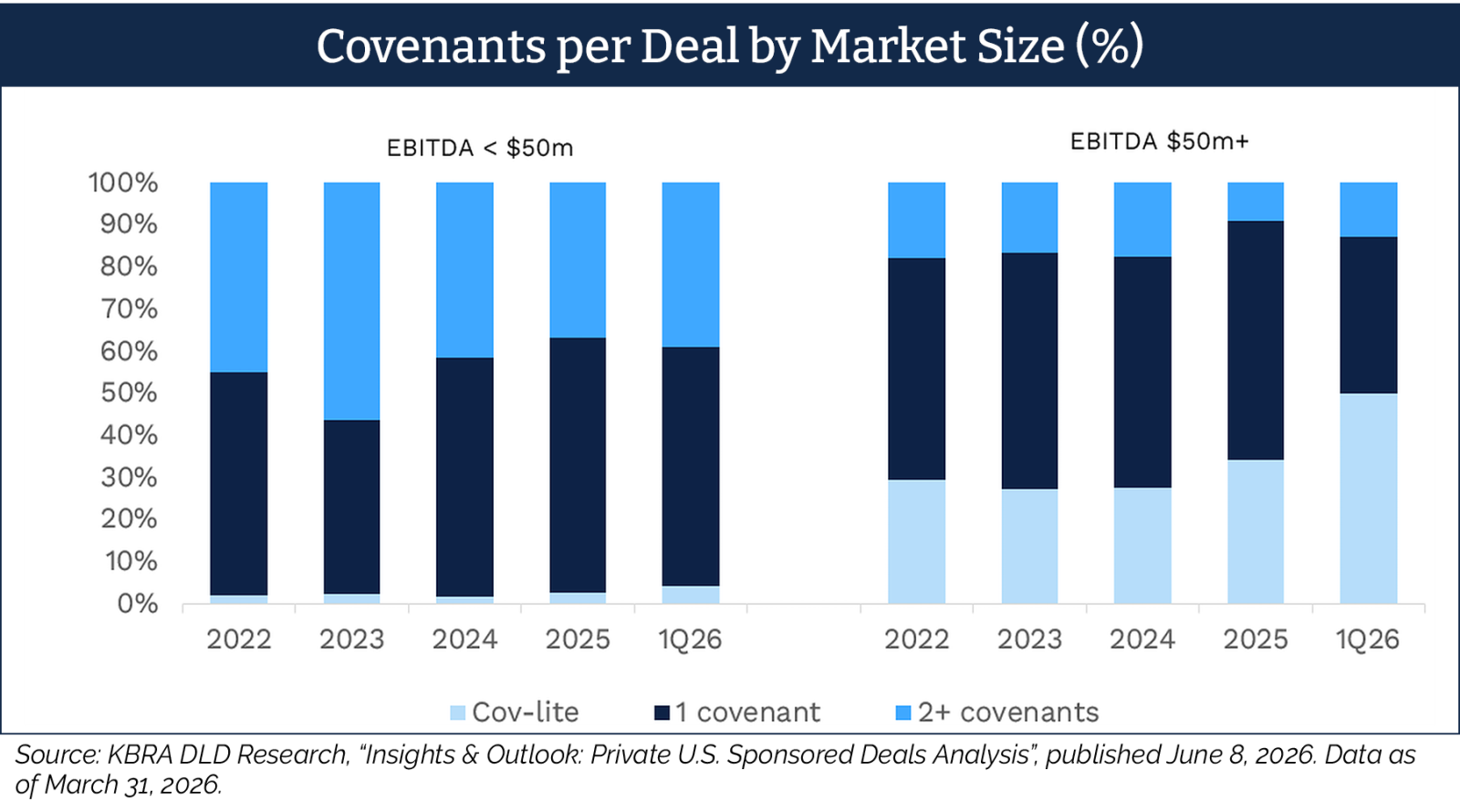
Maintenance covenants provide lenders with early warning signals and a seat at the table before problems escalate. When a borrower breaches a covenant, lenders can reassess risk, engage with sponsors, and pursue corrective actions while options remain. Without such protections, lenders may be forced to wait for a payment default, often resulting in reduced recovery outcomes.
Further, financial covenants alone are not sufficient; they must be structured appropriately to be effective. A disciplined manager knows how to establish covenants that create real optionality and how to use them to minimize losses after a breach.
A Framework for Manager Selection
As direct lending has matured, one lesson stands out: manager selection drives outcomes. In our view, key indicators of discipline include:
- Thoughtful use of PIK and emphasis on cash yields
- Conservative leverage and underwriting assumptions
- Realistic EBITDA adjustments
- Strong, well-structured covenant protections
- Demonstrated experience within a defined market segment
These factors can collectively determine whether a manager is originating differentiated, defensible credit or simply repackaging risk from more competitive parts of the market.
Ultimately, as the cycle evolves and volatility increases, experience, discipline, and consistency — not scale or headline yield — are the defining characteristics of managers that deliver durable performance when markets turn.
Mr. Choksi is the Deputy Chief Investment Officer responsible for managing CIFC Direct Lending’s investment functions and serves as a committee member of the Investment Committee. He has over 31 years of experience in large corporate and middle-market leveraged lending transactions, including senior debt, junior debt, and structured equity, across a wide range of industries. Prior to CIFC, Mr. Choksi held various positions at GE Capital Corporate Lending, most recently leading the Financial Intermediaries Group in New York as Managing Director. Prior to GE Capital Corporate Lending, Mr. Choksi served as an Auditor with GE Capital Audit Staff. Mr. Choksi is a frequent speaker on middle market leveraged lending. Mr. Choksi holds a Master of Science, Finance from Purdue University, Krannert School of Management and a Bachelor of Commerce, Accounting and Economics from the University of Bombay, H.R. College.
Disclosures: This article has been prepared by CIFC Asset Management LLC and its affiliates (collectively, “CIFC”). This article is for informational purposes only. This article is not, and is not intended to be, an offer to sell, or a solicitation of an offer to purchase, any securities or any other interest in CIFC or in any fund, account or other investment product or assets managed by CIFC or to offer any services. This article is provided to you on the understanding that, as a sophisticated institutional investor, you will understand and accept its inherent limitations, and will not rely on it in making any investment decision. For further disclosures, please refer to https://adviserinfo.sec.gov/
This article is reflective of CIFC’s opinions and assumptions, which are subject to change without notice.
Past performance is not indicative of future results. Any investment is subject to risk.