
The Case for Real Estate in Today's Bond Market
By: Sabrina Unger, American Realty Advisors
Pension fund members will understand how private real estate’s income profile compares favorably to bonds, offering similarly stable and predictable cash flows but with the potential for higher returns. The article highlights why this income-driven structure can serve as a compelling complement to fixed income in supporting retirement portfolios in today’s market environment.

For much of the past decade, private real estate offered a meaningful yield advantage over bonds – even as cap rates compressed, the spread remained healthy enough to make real estate an attractive choice.
Today, that cushion has narrowed considerably (Figure 1). Bonds are finally paying investors in a way that is competitive with real estate investment. But if you dig further, there is more to real estate investment than just yields – and we believe those nuances make a stronger case for the asset class today than ever before.
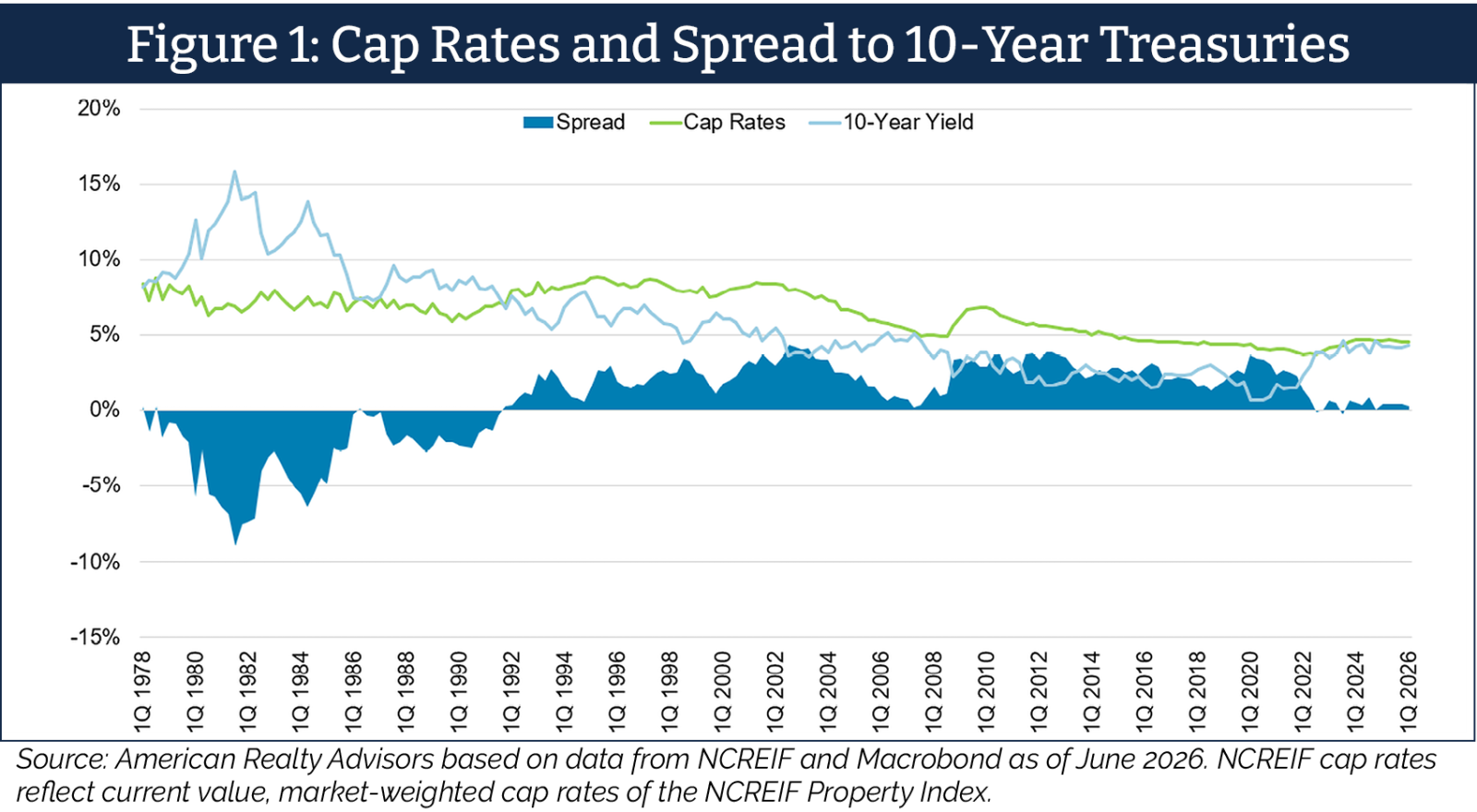
Real estate cap rates, the “yield to price” ratio, are most often compared to yields on a 10-Year Treasury bond: most institutional investors view real estate as a long-term investment so a 10-year bond should be an appropriate “risk-free” benchmark. As shown in the rightmost section of Figure 1, spreads today appear modest compared to the period leading up to and immediately surrounding the pandemic. However, capital continues to flow into the asset class – why?
Part of the reason is that most investors are focused not on yield, but on total returns achieved for the portfolio, and over a full 10-year hold period, private core real estate has tended to outperform the total returns achieved in bonds (Figure 2).
In bonds, the components of returns are income, or the coupon that the bond pays you to hold it, and price change - if rates fall after you buy, your bond becomes more valuable because it is paying more than new bonds. If rates rise, the opposite is true. For real estate, though, returns are derived not only from existing income (current yield), but also from any income growth from rent growth, and operational improvements after capital expense (sometimes referred to collectively as net operating income, or NOI, growth).
With more levers to pull, there are more options for achieving attractive performance.
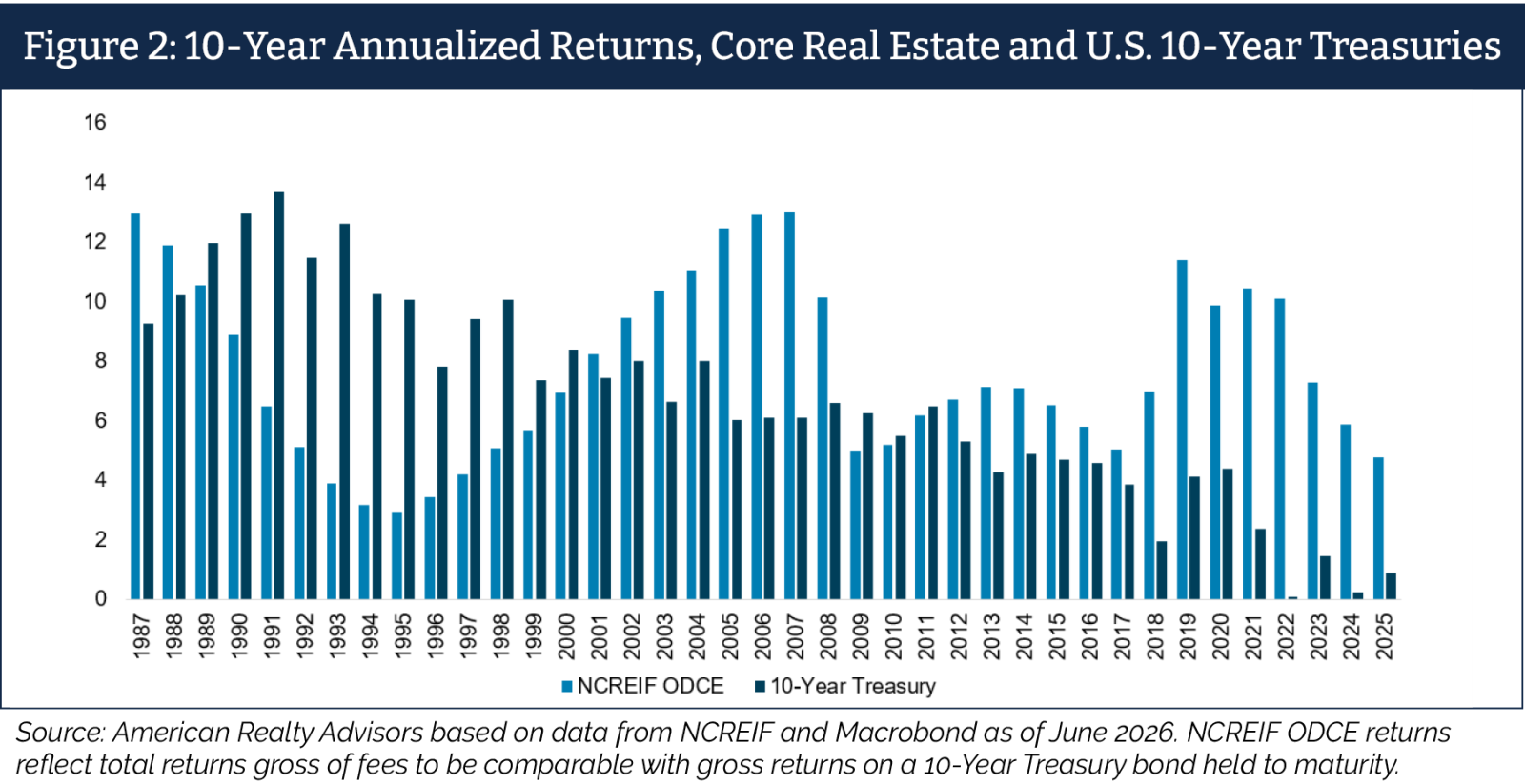
The one period where bonds meaningfully outperformed core real estate – the early 1990s – was the tail end of a historic bond bull market (Figure 2). Rates had fallen dramatically from their early 1980s peak, moving from 15-16% in 1981 to roughly 8% by the end of the decade, and, as noted earlier, falling rates mean rising bond prices.
With Treasury yields still below prior cycles and persistent deficits likely to limit further declines, bonds have less room to deliver outsized returns through price appreciation. Real estate presents a different profile. Its income can grow over time through NOI expansion, while bond coupons remain fixed.
That difference matters. Real estate can generate returns from multiple sources, including current income, income growth, and diversification benefits. In a market where bond upside is constrained, those additional levels carry more weight. As a result, the case for core real estate extends beyond a simple yield comparison. It rests on the ability to grow income and contribute to total return in ways bonds cannot.
Sabrina Unger is a Managing Director and Head of Research & Strategy at American Realty Advisors, where she leads the firm’s research initiatives and partners with investment and portfolio management teams to support acquisitions and strategy development. She also serves on the firm’s Investment Committee. Prior to joining ARA, Ms. Unger was part of the Global Research team at Invesco Real Estate, contributing to global portfolio strategy and thought leadership. Earlier in her career, she held research roles at Clarion Partners and worked as a real estate strategist within a sports entertainment organization.
Ms. Unger is a published author in leading industry outlets, including Real Assets Adviser, ANREV, NCREIF, and AFIRE. She is a recipient of the 2025 Connect Money Next Gen Alternative Investment award and was named a GlobeSt. Woman of Influence in 2022. She holds degrees from Southern Illinois University and DePaul University.
Disclosures: The information in this document is as of June 24, 2026, and is for your informational and educational purposes only, is not intended to be relied on to make any investment decisions, and is neither an offer to sell nor a solicitation of an offer to buy any securities or financial instruments in any jurisdiction. This document contains a mix of (i) statements of fact and (ii) opinions, beliefs, estimates, expectations, and other forward-looking statements. Statements of fact are based on information we believe to be reliable, but we do not represent that all such information is complete or accurate in all respects. Opinions, beliefs, estimates, and forward-looking statements are inherently uncertain, are based on judgment and assumptions as of the date indicated and may change without notice. They are not guarantees of future results. Except as required by law, ARA assumes no obligation to update any such forward-looking statements. This document is proprietary to ARA and may not be copied, reproduced, republished, or posted in whole or in part, in any form and may not be circulated or redelivered to any person without the prior written consent of ARA.