
Public Pensions Reach Strongest Fiscal Sustainability Position in More Than 20 Years
Media Contact: Lizzy Lees (llees@ncpers.org)
WASHINGTON, D.C., August 26, 2026 — Public pensions have reached their strongest fiscal sustainability position in more than 20 years as they continue to make significant progress towards aligning long-term pension obligations with the economies that support them.
NCPERS’ new research shows that in 2018, 45 states had pension liabilities growing faster than their economies. Today, that number has fallen to just two.
The report, Measuring the Fiscal Sustainability of Public Pensions, builds on NCPERS’ sustainability valuation framework, introduced in 2022 as a complement to traditional pension funding measures. Much as a homeowner evaluates a 30-year mortgage against decades of income rather than a single year’s paycheck, the framework allows pension liabilities to be evaluated against long-term economic capacity.
Analyzing data from 2002 through 2024, the research finds:
- National Pension Liabilities Are Sustainable: Pension liabilities relative to economic capacity have declined steadily in recent years. The report finds that the national sustainability ratio has remained below its long-term average for four consecutive years, the longest sustained period of below-benchmark sustainability since 2002–2008, and now stands at its lowest point in the 23-year study window.
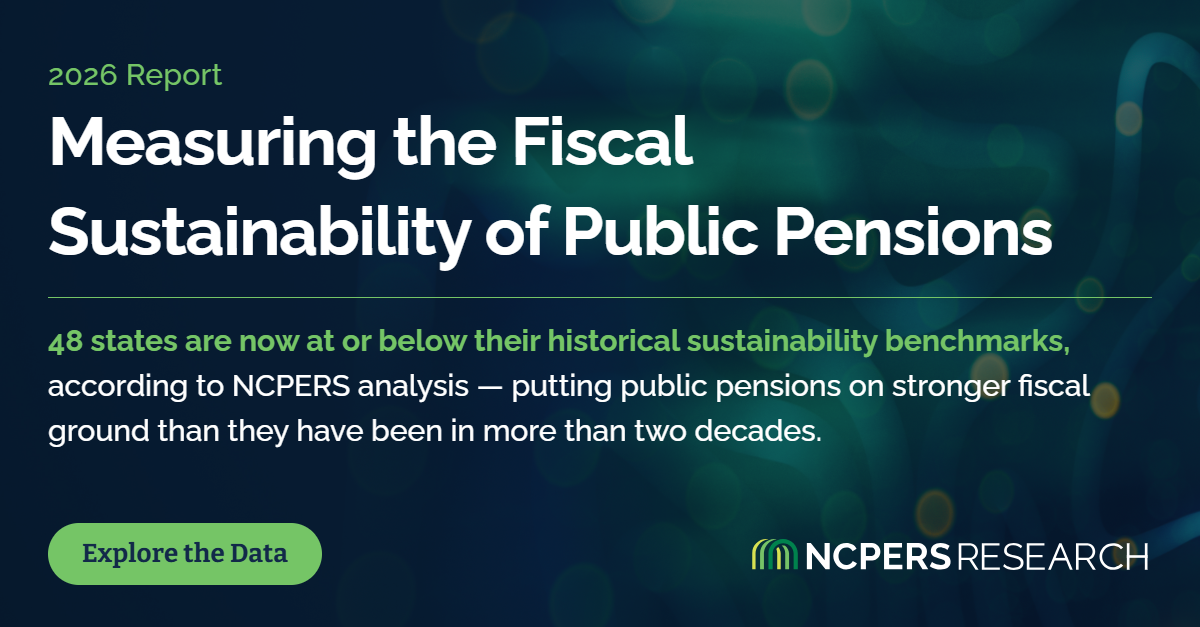
- 48 States Are at or Below Their Sustainability Benchmarks: The research evaluates each state’s pension obligations against its own historical sustainability benchmark. As of 2024, 48 states are at or below those benchmarks, representing the strongest overall position in more than 20 years.
- Even the Most Stressed States Have Made Progress: Illinois, the original study’s most prominent example of fiscal sustainability challenges, spent twelve consecutive years above its sustainability benchmark from 2010 through 2021. In 2022 it crossed back below that benchmark for the first time in over a decade, and it remains below it today.
"For too long, conversations about public pensions have focused almost exclusively on liabilities without considering the economic capacity that supports them," said Hank Kim, CEO of NCPERS. "This research shows that public pension systems are not only meeting their obligations, but doing so in a way that is increasingly sustainable relative to economic growth."
What Makes a Pension Fiscally Sustainable?
Rather than comparing long-term pension liabilities to a single year’s government revenue, the sustainability valuation framework evaluates 30-year pension liabilities against 30-year personal income.
Each state’s historical average ratio serves as its sustainability benchmark, providing a measure of what fiscal stability has looked like over time. The latest analysis finds that nearly every state is currently meeting or outperforming that benchmark.
The report includes a comprehensive state-by-state sustainability analysis covering 2002 through 2024, allowing stakeholders to compare pension obligations, economic capacity, and long-term trends across all 50 states.
Sustainability Valuation: A Practical Tool for Policymakers
The study emphasizes that sustainability valuation is not a replacement for actuarial funding practices, but an additional tool that helps policymakers assess pension obligations in the broader context of long-term economic growth and taxpayer capacity. NCPERS recommends using sustainability valuation alongside existing funding measures to better evaluate the long-term fiscal health of public retirement systems.
“The data show a remarkable improvement in the fiscal sustainability of public pensions over a relatively short period of time,” said Matt Eckel, Director of Research at NCPERS. “The findings demonstrate that responsible funding practices, disciplined management, and a long-term perspective can strengthen retirement systems while preserving the retirement security that millions of public employees and retirees rely on.”
Download the full report (PDF) and explore the state-by-state analysis, now available on NCPERS’ website.
To learn more, register for our September 15 webinar, State Budgets & Public Pensions: What to Watch in the Next Budget Cycle, where NCPERS’ Matt Eckel will explore the research findings and current fiscal trends in greater detail.
About NCPERS
Since 1941, NCPERS has been the trusted partner for public pension leaders across local, county, and state retirement systems. Through practical education, timely insights, and a welcoming peer community, we help members strengthen their funds and secure the futures of more than 20 million teachers, police officers, firefighters, municipal workers, and other public servants.
Headquartered in Washington, D.C., NCPERS is a 501(c)(3) nonprofit organization proudly representing a diverse membership that includes more than 650 public sector retirement systems, plan sponsors, unions, and service providers who collectively manage approximately $7 trillion in retirement assets.
NCPERS is more than an association. We are the industry’s hub for connection, catalyst for progress, and partner working to strengthen retirement systems for generations to come.
###