Empathy-Based Design, AI, and Member Trust: Beth Hallmark on the Future of Pension Communications
By: Lizzy Lees, Director of Communications, NCPERS
Beth Hallmark, Chief Communications Officer at the Teacher Retirement System of Texas, shares insights on digital transformation, AI, empathy-based design, and leadership in public pension communications.
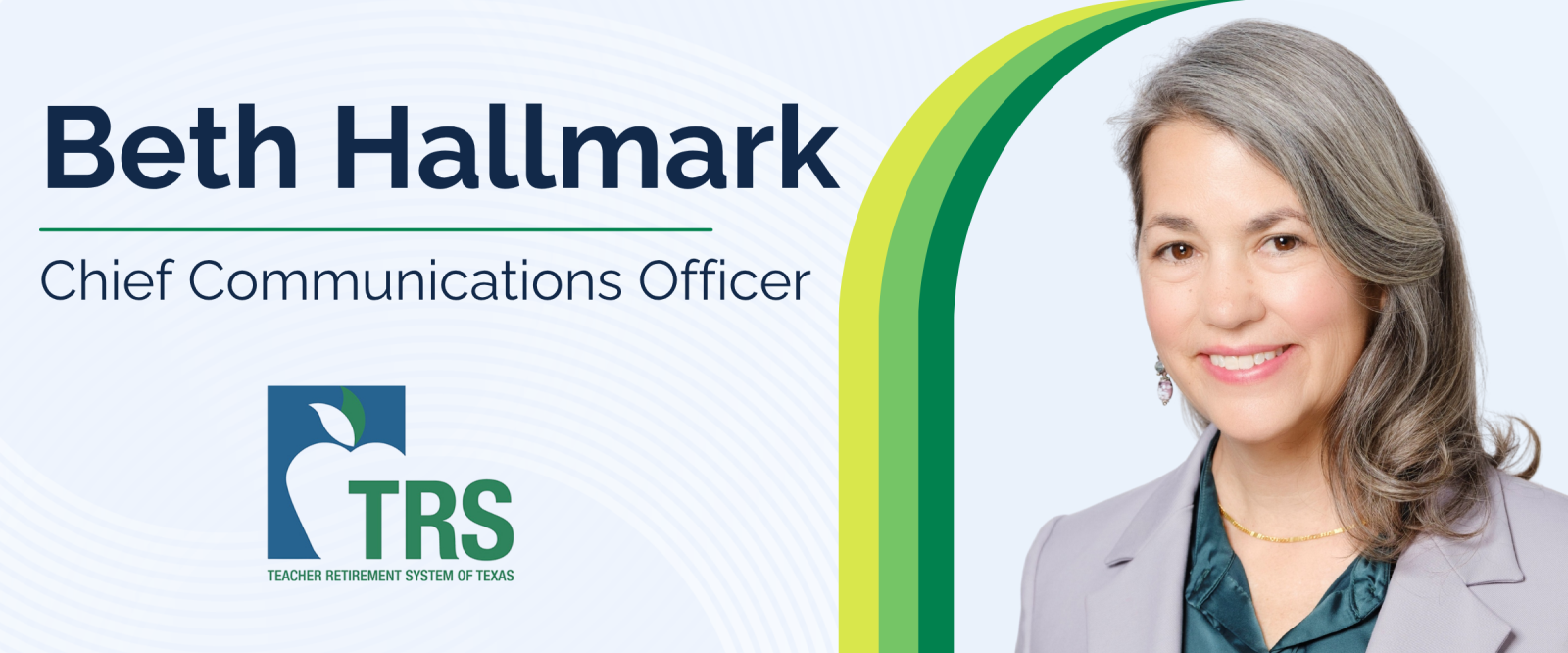
In celebration of Women’s History Month, NCPERS is highlighting the unique career paths of women shaping the future of the public pension industry.
Beth Hallmark, Chief Communications Officer for the Teacher Retirement System of Texas (TRS), is redefining how millions of members engage with their pension system. Through a recent digital transformation, she led the reimagining of TRS’s website and communications strategy — prioritizing accessible design, emerging technology, and a member-centered experience.
And at this year’s Communications & Member Services Summit, her leadership skills, creativity, and the notable impact of her work were recognized when she was honored with NCPERS 2026 Public Pension Communicator of the Year Award.
We spoke with Beth about member‑centered communications, empathy‑driven design, artificial intelligence, and her career in public service.
What initially drew you to the public pension industry?
It is an honor and a privilege to be of service to those who have dedicated their life to public education. I credit my sixth-grade teacher with inspiring in me a lifelong love of reading and the written word, which ultimately drew me to communications as a career. So, it feels like a full-circle moment to apply my 30 years of communications experience to the mission of the Teacher Retirement System of Texas. I’ve also been blessed in my career to work with many incredible public sector employees, but I can honestly say that the people I work with and for in the public pension industry are the very best.
Is there a moment in your career you’re most proud of?
The moments in my career that have meant the most to me have been when a major initiative or complex team project crosses the finish line successfully. What makes me most proud in these moments is the dedication and collaboration of everyone involved. It’s those shared successes that resonate the strongest. A recent example was when we rolled out our new and improved website, which represented so much hard work and coordination by several teams, including ours. We watched together as our new, improved website launched seamlessly—a truly wonderful moment.
What advice would you give to women entering the public pension industry today?
The advice I would give to any woman in any industry is to recognize and believe in your skills, talents, and abilities. You are amazing, and it’s ok to own that. I personally believe that public service is a calling, and that it calls the best. If you find yourself drawn to the public pension industry, it’s because you care about work that matters and makes a positive difference. And I would encourage you to answer that call. You’ll be challenged and inspired.
When you think about reaching millions of members with very different needs, what principles guide how you design communications that are both clear and human-centered?
Communicating effectively is about creating an ongoing dialogue, so listening is one of our most important principles. This means continuously gathering feedback and acting on it. It means engaging transparently with our members, avoiding assumptions about their needs, and meeting members where they are across different communication channels.
Another principle is focusing on what matters most to the people we serve. Every year, we plan our priorities around our Member and Employer Outreach Plan, with 2025 being especially important due to major initiatives such as a headquarters move, a new website, and the launch of new dental and vision plans for our retirees. We also measure all of our communications so we know what’s working well and what may need additional improvement.
And lastly, we welcome opportunities to learn from our peers, share ideas, and collaborate, recognizing that collective knowledge is greater than any single organization’s efforts.
You recently led a major digital transformation including a full website redesign and new research-driven approaches to member experience. What was the most important lesson you learned from putting members at the center of that work?
My “aha" moment was thinking one step beyond user-centered design to the idea of empathy-based design. This approach considers the holistic experience any member may be facing as they engage with TRS.
For example, a new teacher in a classroom for the first time is navigating a new job, a new career, and sometimes even a new city — that’s a lot to manage without also having to understand and plan for retirement. Or think about the person approaching retirement and making one of the key decisions in their life and career. It’s a lot to consider and it can be emotional and sometimes overwhelming.
Empathetic design means being intentional about timing, clarity, and simplicity; clearly separating must-know information from nice-to-know details; breaking complex decisions into manageable steps; reducing cognitive load where you can to make understanding easier; and using strong visual design and multiple formats (guides, videos, conversations) to meet different needs and styles.
You’ve invested heavily in building internal capabilities rather than relying solely on outside vendors. Why was that important to you, and how has it changed the way your organization serves members?
No one understands TRS or its members better than those who daily commit their time to TRS’ mission. Drawing on prior experience, I made this decision based on confidence that internal staff could efficiently and cost-effectively deliver the user experience research, information architecture, and visual design needed for success.
Delivering an improved experience on our website also meant diving deeply into understanding our members’ needs, talking with them, and collaborating with all of our other business units at TRS. This not only benefited the new site, but also all of our other communications work. By investing in our in-house expertise, we are better positioned to respond with agility as technology and our members’ needs evolve.
Beyond your organization, you’ve helped advance communications practices across the public pension community, including work around AI and collaboration with other agencies. Why do you believe communications leaders need a seat at the table as these systems evolve?
Communications leaders should play a leading role in the application and understanding of new and evolving tools such as artificial intelligence. Generative AI tools, for example, are large language models, and language is one of the most powerful human communication tools.
These types of tools are fundamentally changing how information is created, conveyed, and found. The era of searching for information is quickly being replaced with the era of simply asking for it. This means communicators must also focus on how the people they serve use AI to find information.
In turn, this elevates the importance of content strategy — ensuring the entire communications ecosystem is a clear, accurate, and consistent source of truth. Communicators must actively manage how AI systems “see” their organizations by aligning content across channels, testing how public AI platforms answer questions about them, and actively monitoring for and correcting misinformation. It’s both daunting and exciting, because we have the opportunity to harness some of the most powerful information and communication tools that we’ve seen in our lifetimes to get the right information to the right people in the right way.
Why do you think it’s important for women to be in the C-suite?
It’s important for smart, thoughtful, and strategic leaders to be in the C-suite — and that also happens to describe most of the women I know. I’ve worked for some incredible women over the years and can state without hesitation that women leaders have been my most powerful mentors.
Looking back, what advice would you give yourself early on in your career?
This one is easy: I would tell myself to worry less and enjoy more. Early on in my career, I was hard on myself and often second-guessed my abilities. The truth is, if you are giving your best, learning from your mistakes, reaching for growth opportunities, and connecting with those who inspire you, then you are going to succeed! Relax. Trust. Work hard but also know that you are defined by much more than just your job title.