How Could AI Help Public DC Plans?
By: Thomas Anichini, GuidedChoice
When people hear “AI,” they often think of large language models and virtual assistants. But for public Defined Contribution (DC) plans, AI may prove just as valuable in areas like prediction, pattern recognition, workflow automation, and decision support.

Plan staff deal with recurring friction:
- Participants submit incomplete forms
- New employees miss enrollment steps
- Near-retirees seek help only when key decisions are close
- Communications staff keeps rewriting standard explanations
- Service teams answer the same loan and withdrawal questions repeatedly
- Operations staff sort routine items from urgent ones before they can solve either
These are the places where AI help first.
Use LLMs Where Staff Lose Time
Some of the clearest uses for AI are language-heavy tasks that already consume staff time.
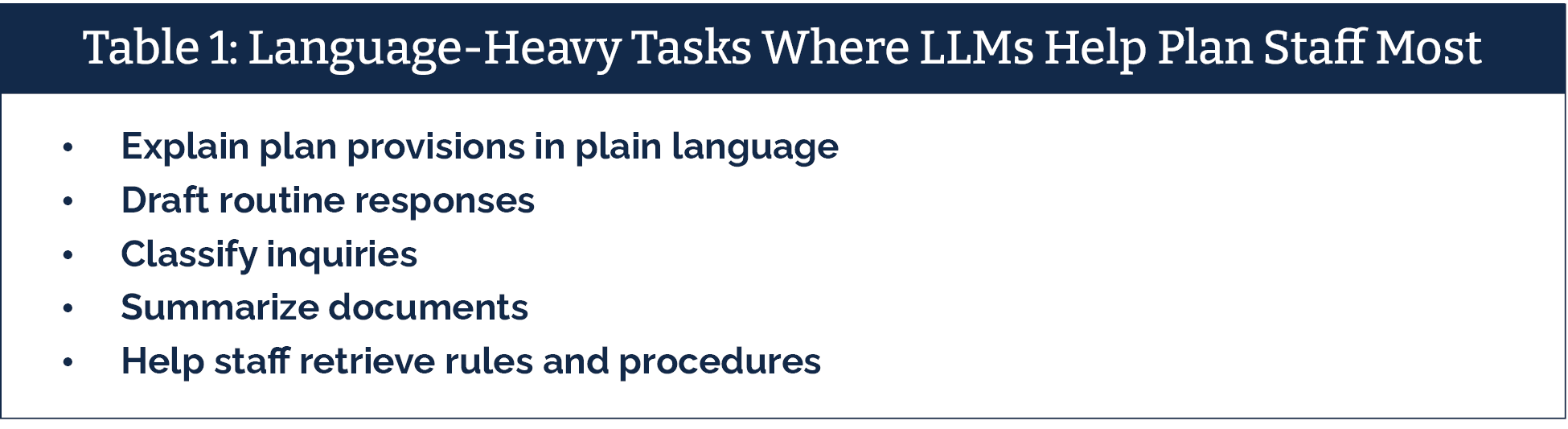
Plan staff answer routine questions, rewrite technical language, sort incoming messages, and hunt for the right policy or procedure. Large language models fit that work. They can summarize documents, classify inquiries, draft plain-language responses, and help staff retrieve plan rules quickly.
That matters because much of plan administration depends on explanation. A participant asks about a loan. Another submits a withdrawal form with a missing field. A third wants to know how a beneficiary change works. Before staff can solve these problems, they often must explain the rules, restate them in clearer language, and direct the case to the right queue.
LLMs help with that routine work. They reduce repetitive drafting, speed up routine triage, and help staff respond more consistently.
Much of this work is language-heavy: explaining, rewriting, sorting, and retrieving.
- Explain plan provisions in plain language
- Draft routine responses
- Classify inquiries
- Summarize documents
- Help staff retrieve rules and procedures
Use AI Predictive Models Where Timing Matters
Other problems in DC administration are less about explanation than about timing.
Some failure points are familiar:
- A participant borrows repeatedly
- A worker leaves service and takes a cash distribution
- A worker maintains an unsuitable allocation for years
- A near-retiree reaches distribution without a drawdown plan
These are familiar failure points in DC administration.
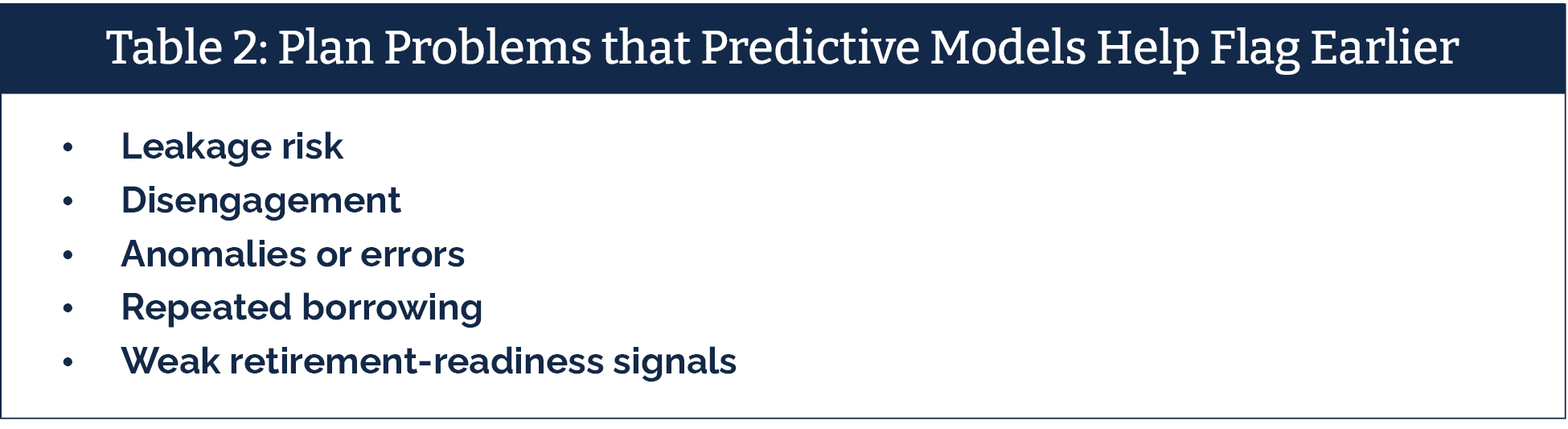
Predictive and analytic models fit this work better than chat tools do. They can look for patterns in structured data and help the plan identify which participants are more likely to cash out after separation, disengage, miss key steps, or approach retirement unprepared.
Predictive models help the plan spot these risks sooner.
A plan that can identify likely cash-outs could send earlier messages about preservation and rollover options. A plan that can spot disengaged participants might target education before the gap widens. A plan that can detect anomalies can catch errors before they spread.
The next kind of work: find patterns earlier so the plan pre-empts unwanted outcomes.
- Leakage risk
- Disengagement
- Anomalies or errors
- Repeated borrowing
- Weak retirement-readiness signals
Where AI Would Help Plan Staff Most
The value is clear when you consider where plan staff lose time.
- Communications staff rewrite standard explanations in multiple formats
- Service teams triage surges of participant questions after market events, annual notices, or rule changes
- Operations staff identify incomplete forms, extract key information, and route cases before backlog builds
- Education teams tailor messages for new hires, mid-career workers, and near-retirees
- Plan leadership see where participants get stuck and where routine processes fail
AI can help plan staff do their jobs with less delay, less repetition, and better timing.
Keep Judgment With Staff
For all AI can help with supporting routines and raising alerts, staff should still make the decisions that affect participant options and outcomes.
A model may help explain a projection, a system may help draft communication, and a tool may flag a high-risk case. However, staff should still validate the numbers, choose the intervention, and decide what happens next.
That boundary matters even more in public plans than in private ones, due to the legal duties, privacy obligations, procurement rules, and scrutiny public plans face. Any tool that affects participant communications, case handling, or targeted outreach must remain reviewable and accountable.
Thus, AI should assist staff, not decide for them.
Evaluate Tools by Plan Problems
Public DC plans should judge AI tools by the work their staff face.
Does the tool reduce delay? Does it help staff answer routine questions more clearly? Does it flag incomplete forms before backlog builds? Does it help identify likely cash-outs early enough to matter? Can staff monitor it, explain it, and override it when needed? These are the right questions.
Use AI where it cuts delay, reduces repetitive work, and helps plan staff stave off regrettable results. That is the case for AI in public plans: better execution of the work that already shapes participant outcomes.
About the author: Thomas Anichini, CFA, CFP, is Chief Investment Strategist with GuidedChoice / 3Nickels, with over 30 years of actuarial and investment experience.
Tom is a member of GuidedChoice’s Investment Committee. He refines GuidedChoice’s capital market assumptions and proprietary return model, and also contributes to GuidedChoice’s retirement advice engine and 3Nickels financial advice engine. Tom communicates about the firm’s philosophy and advice, and represents the investment team when facing clients and consultants.
Prior to joining the firm, Tom gained experience in various actuarial, investment consulting, and portfolio management positions, including for EnnisKnupp & Associates, Mercer, Westpeak Global Advisors, and Freeman Investment Management.