
Pension Partner of the Year: J.P. Morgan Asset Management on Risk, Governance & Trustee Education
By: Lizzy Lees, Director of Communications, NCPERS
J.P. Morgan Asset Management was recently recognized with the 2026 Pension Partner of the Year Award for their engagement with NCPERS’ educational conferences and commitment to promoting fiduciary best practices. The awards were presented May 19 in Las Vegas during NCPERS 2026 Annual Conference & Exhibition (ACE), one of the longest-running educational events for public pension professionals.
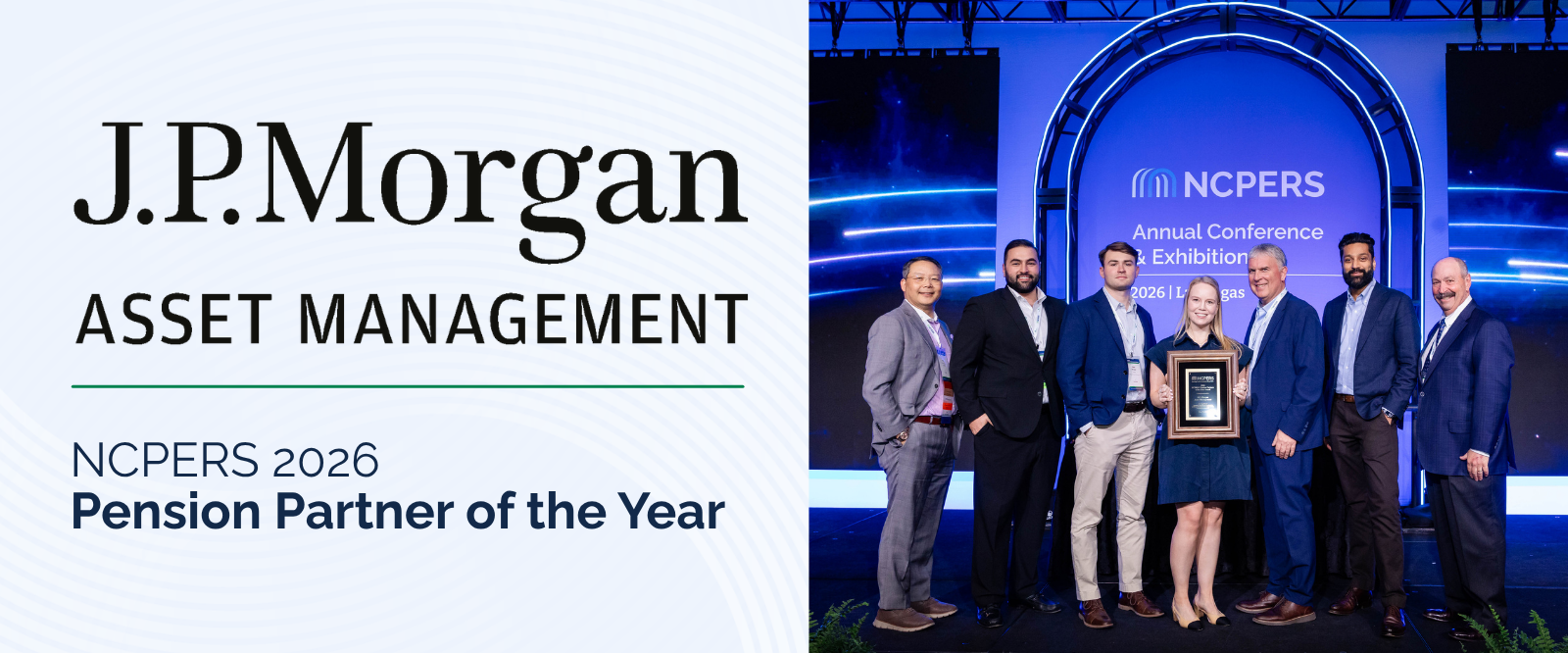
We spoke with Jeffrey Fox, Head of US Public Funds for J.P. Morgan Asset Management, about how the public pension landscape has evolved, what areas trustees should prioritize in their continuing education, and their outlook for AI’s impact on the industry.
Tell us about your day-to-day role at J.P. Morgan Asset Management.
Jeffrey Fox: As Head of US Public Funds, my day-to-day focus is helping public pension staff, trustees, and consultants make well-informed, fiduciary decisions by connecting them to the full resources of J.P. Morgan. My role includes coordinating portfolio reviews, bringing timely market and manager insights, and facilitating access to our investment teams across public and private markets.
I spend a lot of time listening and understanding each plan’s objectives, governance structure, liquidity needs, and risk constraints, then translating that into practical solutions, education, and implementation support. J.P. Morgan Asset Management is a long-term partner to its clients, helping them stay disciplined through market cycles while continuously looking for ways to improve decision-making and investment outcomes.
How have you seen the public pension landscape evolve in recent years?
Jeffrey Fox: The landscape has become more complex. Many plans have increased reliance on diversified sources of return, including private markets, opportunistic strategies, and more dynamic public market exposures, while also facing greater demands for liquidity planning and cost transparency. Governance has continued to professionalize, with stronger emphasis on policy discipline, risk management, and implementation oversight.
At the same time, stakeholders expect clearer communication around funded status, contribution policy, and portfolio risks. We’ve also seen increased interest in responsible investing, regulatory considerations, and the operational capabilities required to manage more sophisticated portfolios.
Overall, public pensions are being asked to do more: deliver durable outcomes, manage volatility, and maintain public trust, often with limited resources, making education and partner support even more important.
In today’s environment, what areas do you think trustees should prioritize within their continuing education?
Jeffrey Fox: I’d prioritize four areas:
- Portfolio resilience: understanding the drivers of returns and risk across market regimes, including inflation sensitivity, market beta, and liquidity.
- Private markets governance: pacing, liquidity management, fees, and operational due diligence, especially as allocations grow.
- Risk oversight and implementation: how factor exposures, concentration, leverage, and tail risks show up at the total-fund level, and how rebalancing and cash management impact outcomes.
- Fiduciary process and decision quality: documenting decisions, avoiding behavioral biases, and ensuring policies (IPS, rebalancing, delegation) match the plan’s real constraints.
Education that ties these topics back to scenario analysis and real-world tradeoffs can help trustees move from theory to better decisions.
Learning is often a two-way street. What unique perspective does J.P. Morgan offer its public pension clients, and what have you learned from them?
Jeffrey Fox: Our perspective is shaped by breadth: we can bring global market and economic views, deep asset-class expertise across public and private markets, and robust risk and portfolio construction capabilities, then tailor that into practical, fiduciary-driven insights.
We also see how different plans solve similar challenges, which helps clients benchmark governance practices, reporting, and implementation approaches. Just as important, we’ve learned a great deal from public pension clients about stewardship: how to balance long-term obligations with public accountability, how to run durable governance processes, and how to stay disciplined when markets and headlines create pressure. Public pensions are often models of long-horizon thinking, and that reinforces our focus on process, transparency, and partnership.
How do you see AI impacting public pension administration in the next decade?
Jeffrey Fox: AI has the potential to impact how plans operate in a few ways: workflow efficiency (drafting board materials, meeting minutes, policy documentation, and RFP/RFI responses), data and oversight (automating data validation, performance/risk reporting, and exception monitoring), and decision support (scenario analysis, stress testing, and surfacing key portfolio drivers in plain language).
The caution is that fiduciary responsibility doesn’t get automated: plans will need strong controls around data quality, model risk, privacy, and auditability.
Why is it important to J.P. Morgan to support public pensions?
Jeffrey Fox: Public pensions are foundational institutions that help deliver retirement security for teachers, firefighters, public employees, and many others who serve communities. Supporting public pensions aligns with our long-term orientation: public plans are multi-decade investors, and they can benefit from partners who commit through market cycles with consistency, transparency, and strong risk management.
We also believe education is a core part of fiduciary support. When trustees and staff have access to high-quality learning on markets, governance, and implementation, they can make better decisions for beneficiaries and communities. Our goal is to be a trusted partner that helps plans strengthen process, build resilience, and pursue their objectives effectively.