
Bridging Chicago's Pension Gap Through Strategic Land Disposition
By: Melodie Slaughter and Hassaan Ul Haq
At the 2025 Public Pension Funding Forum, Melodie Slaughter and Hassaan Ul Haq competed in the inaugural NCPERS-Harris Pension Lab: NextGen Competition. In this article, they share insights from their winning proposal and reflect on the experience of tackling one of Chicago's most pressing fiscal challenges.

Chicago faces two interconnected crises that demand a unified solution. The city carries more than $36 billion in unfunded pension liabilities across its four primary funds — Municipal, Police, Fire, and Laborers — reflecting a collective funded ratio of just 30 percent. The Municipal Fund stands at roughly 40 percent funded, while both Police and Fire hover near 25 percent, leaving approximately three-quarters of their obligations uncovered. Each year, the city devotes over $3 billion to required pension contributions, yet the gap continues to widen.
Simultaneously, over 20,000 city-owned vacant lots sit idle on the South and West Sides, generating no tax revenue while costing millions annually to maintain — nearly $1,000 per lot. These parcels are concentrated in predominantly Black neighborhoods shaped by decades of redlining, predatory lending, urban renewal, and systematic disinvestment. The roots of this vacancy trace back to the 1940s, when federal maps labeled these communities as “high-risk” for mortgage lending, effectively cutting off residents from credit and homeownership. What followed were waves of arson, blight, and demolition that hollowed out once-thriving areas. Chicago’s pension crisis and its land-use crisis are not separate problems — they are deeply intertwined.
Traditional approaches have failed to address either challenge at scale. The city’s $1 Large Lots Program, launched in 2014, facilitated the sale of over 1,200 parcels but lacked development requirements, leaving many lots undeveloped or in the hands of speculators who allowed properties to deteriorate further. The 2022 consolidation of six programs into ChiBlockBuilder improved transparency and coordination but has not resolved fundamental barriers: bureaucratic processes, short application windows, limited financing options, and an overwhelming focus on residential parcels. Commercially zoned lots — which could generate greater long-term tax revenue — remain largely untapped. The result is that the majority of city-owned properties remain unsold, with the average lot held for nearly three decades.
Our proposal offers a new framework: micro-districting. Rather than selling lots piecemeal, this model bundles city-owned parcels into targeted clusters for coordinated redevelopment. Using geospatial analysis, we identified six key community areas — Englewood, West Englewood, New City, North Lawndale, East Garfield Park, and West Garfield Park — containing over 5,000 vacant lots with significant revenue potential. Logistic regression and random-forest classification models confirmed that proximity to amenities such as CTA stations, grocery stores, and parks strongly predicts lot marketability. In Englewood, for example, greater distance from grocery stores was significantly associated with higher vacancy odds, reinforcing that everyday retail access shapes market outcomes. This evidence supports our core assumption: mixed-use clusters combining residential and commercial parcels can attract greater developer interest by aligning redevelopment with existing neighborhood demand.
The methodology applies spatial proximity modeling (using a 250-meter walking radius) and graph-based clustering to identify compact, walkable redevelopment zones where every lot lies within walking distance of the others. We retained only mixed-use clusters containing at least five lots with both residential and commercial zoning. These pre-assembled “micro-districts” would be offered through a targeted RFP process, scored across five metrics: projected fiscal and economic impact, project feasibility and timeline, inclusion of local buyers and organizations, diversity of project partners, and commitments to measurable community benefit. By lowering per-parcel transaction costs and pairing residential infill with commercial activation, the model maximizes both revenue generation and neighborhood spillover effects.
Financially, this model converts dormant public-sector assets into recurring revenue rather than one-time windfalls. Property taxes from developed lots provide a stable revenue stream less exposed to market volatility than conventional pension fund investments—a form of built-in risk management. Critically, the approach also eliminates ongoing maintenance costs while reclaiming value from parcels that have historically produced none. A dedicated share of proceeds would flow to a pension stabilization lockbox, directly linking land disposition to retirement security for public-sector employees. This alignment between fiscal recovery and community reinvestment makes the policy both economically responsible and socially durable.
No single reform can resolve Chicago’s estimated $36–40 billion pension challenge alone. Micro-districting functions as one component within a broader portfolio of solutions that may include fund consolidation, re-amortization of obligations, and targeted revenue measures. But by transforming long-standing liabilities into investable assets while centering community capacity and addressing the historic, racialized patterns of disinvestment that produced Chicago’s concentrated vacancies, this approach offers a fiscally sound, politically feasible, and equity-focused path forward.
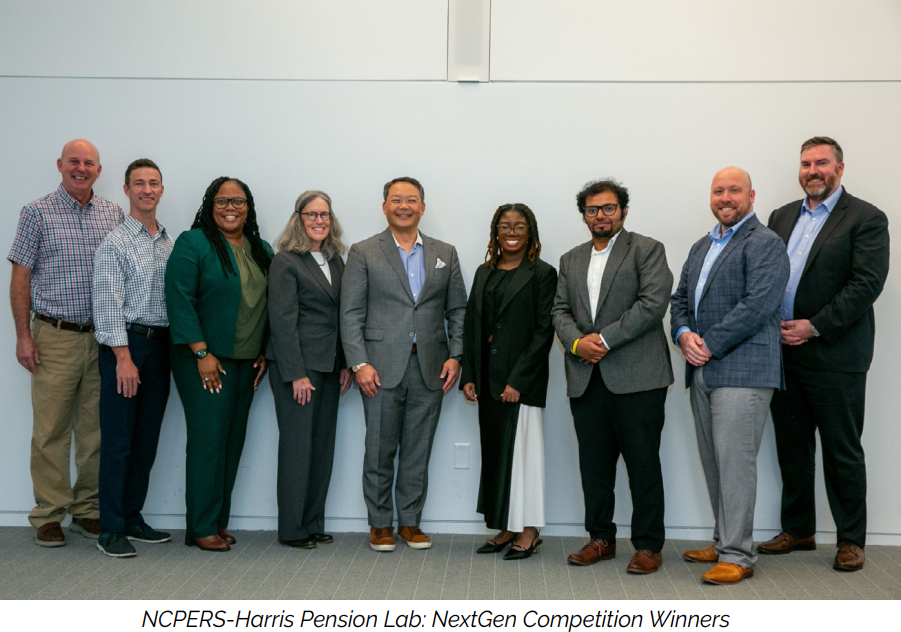
About the authors: Melodie Slaughter is a Master of Public Policy graduate of the University of Chicago Harris School, with training in data analytics, municipal finance, and education policy. Drawing on her lived experience as a disabled Black American from Chicago's south suburbs, her work advances equitable outcomes across public systems, focusing on urban redevelopment and fiscal sustainability.
Hassaan Ul Haq is a Data Scientist and AI professional contributing to mission-driven initiatives at GivingTuesday and co-founder of civic-tech startup RoadSense. With expertise in AI, computer vision, and statistical modeling, he leverages data science and machine learning to solve real-world problems, helping organizations make better decisions and scale their impact in the civic-tech space.