
The Strategic Mandate: Why Leading Fiduciaries Are Embracing REITs
By: David B. Sullivan, Nareit
The article argues that institutional real estate investing is shifting away from an overreliance on private assets toward integrating REITs as a core “portfolio completion” tool under Total Portfolio Allocation frameworks. As global leaders adopt this approach, REITs are positioned not as a tactical add-on but as a strategic mandate for optimizing capital efficiency and agility in modern portfolios.

The institutional real estate market is undergoing a fundamental transformation. Global economic shifts, digital infrastructure growth, and valuation dislocations demand a nimbler approach to capital allocation. Leading institutions now recognize that exclusive reliance on private real estate creates costly structural constraints.
Sophisticated investors — pension funds, sovereign wealth funds, and endowments — are integrating REITs as essential “portfolio completion” tools. This shift is accelerated by the adoption of Total Portfolio Allocation (TPA). REITs’ liquidity and flexibility are a natural fit for TPA, which seeks to optimize capital deployment and agility across all asset types.
Here are five reasons why practitioners should view listed real estate as a critical strategic overlay to maximize portfolio efficiency.
1. Superior Long-Term Net Returns
The perception that private real estate offers superior long-term returns is often challenged by realized performance data, especially after fees.

Analysis from Nareit and CEM Benchmarking shows that REITs outperformed private real estate in defined benefit plans by more than 2.0% annually on a net total return basis over two decades. Investors gain superior transparency and higher performance without taking on disproportionate risk.
2. Diversification and Access to the Modern Economy
REITs fill critical gaps left by traditional real estate benchmarks.
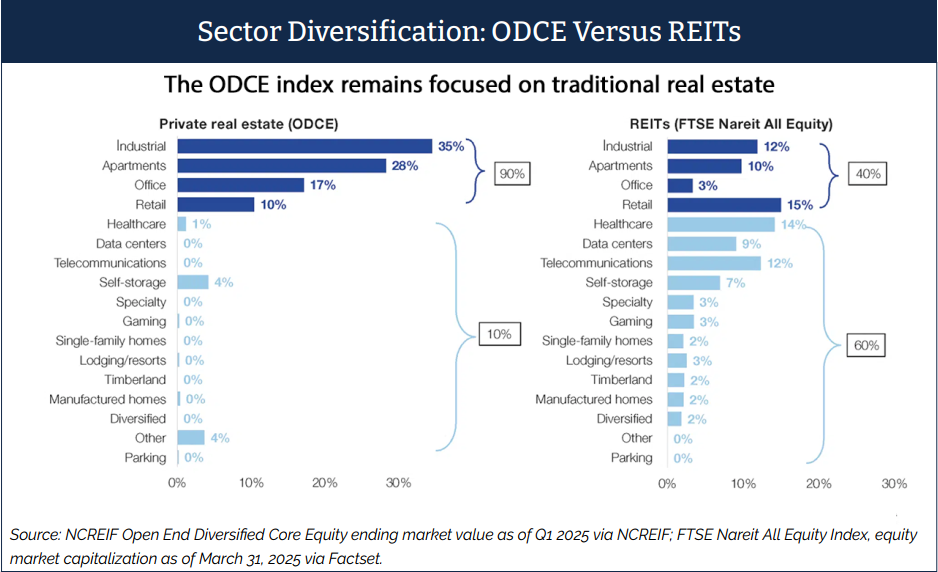
The chart above shows that the NFI-ODCE index remains heavily concentrated in legacy sectors — office, retail, apartment, and industrial. Meanwhile, REITs provide liquid, scaled access to the specialized operating platforms defining the modern economy, such as data centers and cell towers. By using REIT strategies, institutional investors can target high-growth sectors that are difficult to aggregate privately, enhancing portfolio resilience.
3. Liquidity and Tactical Flexibility
Illiquidity is private real estate’s greatest operational weakness. REITs offer daily liquidity that is crucial for modern portfolio management. They provide an efficient mechanism for “pacing” and rebalancing, allowing managers to maintain target allocations when private commitments lag. Furthermore, REITs empower managers to capitalize on valuation dislocations, acquiring high-quality real estate at a discount when share prices trade below net asset value.
4. Transparency and Disciplined Balance Sheets
REITs offer compelling governance advantages. They are subject to reporting under Securities and Exchange Commission regulations, offer daily price discovery, and have continuous analyst scrutiny, all of which combine to provide real-time price signals that simplify risk management. Additionally, the discipline of the bond market encourages conservative leverage (often below 40% loan to value). This combination of governance, robust access to equity and unsecured debt markets, and disciplined management provides vital financial stability.
5. Proven Adoption by Global Leaders
Leading global investors view REITs as an integral component of their portfolios, using “portfolio completion strategies” to mitigate performance gaps. By combining public and private allocations, institutions gain enhanced liquidity and cost-efficient access to specialized operating platforms at scale. Ultimately, 88% of institutional investors now view REITs as a direct form of real estate investment, with the vast majority planning to maintain or increase allocations.
A Mandate for Modern Portfolio Construction
The era of viewing listed real estate as a secondary tool is over. Institutional investors are increasingly leaning on REITs to optimize capital deployment under a TPA framework. Combining private real estate with a REIT allocation delivers higher long-term, net returns while providing unparalleled agility. Embracing REITs is no longer an optional tactic — it is a strategic mandate for the modern fiduciary.
About the author: David B. Sullivan leads institutional pension plan, foundation and endowment outreach for Nareit, which entails promoting and facilitating real estate investment through REITs to institutional investors and their consultants worldwide. This includes organizing roadshows, hosting meetings and other marketing outreach targeted to institutional real estate investment officers around the world.
Prior to joining Nareit, Mr. Sullivan was an institutional real estate capital raising and marketing professional focused on the global real estate market, a role he held for twenty years at firms including Schroders, Barings and CBRE.
Mr. Sullivan has an MBA from Columbia Business School, an MPhil in International Relations from Cambridge University, and a BA in International Relations from Boston University.
About Nareit: Nareit is the worldwide representative voice for U.S. listed real estate. Its mission is to actively advocate for REIT-based real estate investment with policymakers in the US and abroad as well as the global investment community.